Last updated on 9 July 2020
I start a section dedicated to tutorials and step-by-steps usable for your courses or to facilitate the handling of certain digital tools.

Table of Contents
Making a Real Movie – Tips for Making a Film Screenplay
This article is proposed by Adobe as part of its partnership with "JE FILME LE METIER QUI ME PLAIT".
Making a film means belonging to a new family: filmmakers. And in this family, Alfred Hitchcock is one of the most glorious elders, of those who invented everything. Hitchcock has even experienced the transition from silent to talking cinema, which has helped him a lot in writing films, but we will talk about it again. The book "Hitchcock" written by another director, French and legendary, François Truffaut, is considered a bible by the greatest filmmakers.
The audio interviews between Alfred Hitchcock and François Truffaut, retracing the master's career and his vision of cinema, are available free of charge here:
But why does Alfred Hitchcock say that screenplay is the most important thing to make a movie? First of all, what is a script?
A feature film has a duration that usually varies between 1h20 and 2h30, and it takes several years to produce it. On average, 2 years.
The stages of production in the cinema are countless, and fortunately you will not need such a level of detail to make a short film or a video capsule. But the techniques of cinema will help you make a film that you will be proud of.
To make sure you start off on a good footing, we first advise you to produce two very important documents: a script and a storyboard.
The scenario
This is the story told in the simplest and most efficient way possible. It is not about writing a novel but about describing the action, the dialogues and all the important details … Someone who does not know the story and who reads your script must be able to imagine it without any problem.
Here is the screenplay for the first episode of the Stranger Things series:
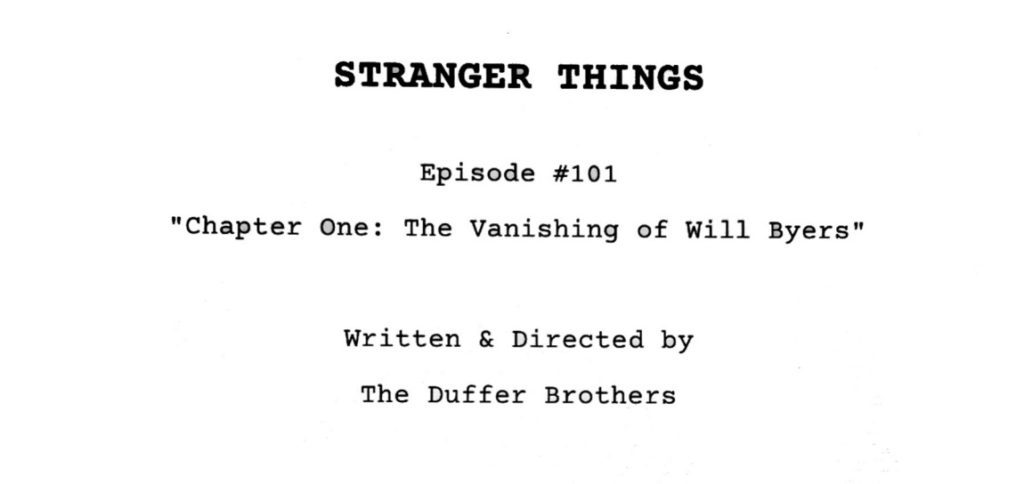
If you've watched the series, it must amuse you to see how accurate and detailed the storyline of this first episode is. It feels like the images are scrolling.
There are many standards and conventions for scriptwriting, so that everyone understands each other on filming.
As far as you are concerned, what is important is that all the people involved in the project (actors, cameraman, … dressmaker) have a reference document, clear and precise. A document that says: This is the story we will tell. »
The storyboard
The storyboard is a kind of comic strip of your future film, based on the scenario. All films and series are drawn with diabolical precision before shooting.
Remember the wall climbing scene in Game of Thrones?
Watch this video:
Amazing, isn't it? All the scenes were drawn like a comic before filming them!
And here is a video that compares the storyboard of "Batman: The Dark Knight" and the images of the film.
Rest assured: there is no need to be a great draftsman. These are:imagine the scenes and thus decide in advance what the actors will do, where the camera will be placed or what decor elements you will need …
This will allow you to visualize and prepare as well as possible the following stages of the production of your film: pre-production, filming and editing.
Some practical tips in stages
1/ What story do you want to tell? Do not hesitate to give yourself time on this moment of creation and sharing. Good stories are often combinations of existing ideas.
- For example, let's imagine that we want to talk about the job of a firefighter.
2/ Whatever the genre of your film (from reportage to fiction), start by trying to Summarize your idea in a single sentence. This is commonly referred to as the Pitch or the argument » in good French.
- Ex: Bastien, 21, will live his first day as a firefighter, a day full of dangers but also of joy.
3/ Start writing your script with a first synopsis: complete summary of your story.
- Ex: Bastien, a 21-year-old boy, wakes up full of energy. After swallowing a hearty breakfast and taking a shower in 30 seconds, he kisses his partner, Marie, who seems anxious.
4/ From this complete synopsis, Write one sentence per scene. In English this stage is called the " step outline ’:
- Bastien, 21, is in the bed of his room with his eyes wide open next to Mary who sleeps.
- The alarm clock goes from 5:59 to 6:00, the alarm barely has time to issue a single note that Bastien has already stopped it energetically and is already standing.
- In his kitchen Bastien swallows a very copious breakfast and swallows a large glass of milk with a milking.
- Bastien showers energetically, he sings.
- As he prepares to leave the apartment, Marie seems worried.
5/ You can now add your dialogues and more details to arrive at a scenario. Let's take for example Scene 5 above, here's how you could transform it:
Bastien comes forward, determined, in the corridor with his bag on his shoulder, ready to leave. But Mary is blocking the door. She wears a large sweater too wide and stares at Bastien. Bastien puts down his bag, serves it hard in his arms. Mary serves him even stronger.
BASTIEN, reassuring
Don't worry, my darling ….
MARIE, sobbing
You're texting me, aren't you?
BASTIEN
I swear to you
MARIE
You're careful, aren't you?
BASTIEN
I swear to you
They kiss one last time and Mary gently opens the door to Bastien.
6/ That's it your scenario is complete, now it's up to the storyboard. The idea is to really show what your film is going to be. Still for Scene 5, you could draw:
- Bastien walks down the hall.
- Marie's blocking the door.
- Bastien drops his bag.
- They're hugging each other.
- They're talking to each other.
- They kiss
- Mary opens the door to Bastien.
Good scenario and good storyboard!
To follow …
This article is the result of a partnership with the company adobe.
Adobe has chosen to engage with young people throughout their educational journey to encourage them to develop their digital skills and creativity. “We believe that the use of our creative applications in the classroom fosters the development of digital skills while providing a creative and concrete approach in teaching and learning knowledge.”
Adobe offers more than 20 creative applications like Photoshop, Illustrator, InDesign, Acrobat PDF. But also adobe Spark, Premiere Rush or Lightroom.
Through its Education program, adobe offers discounted offers to educational institutions and teachers.
More information:
– Offer for teachers: https://adobe.ly/2vBCiUh
– Offer for establishments: https://adobe.ly/37uQRpW
 English