Last updated on 8 June 2026
Looking for a short video to start a classroom debate, explain a topical topic or work on media literacy. But between content that's too long, content that's full of ads, and content that talks to kids from high up, sorting takes time.
OKI solves part of the problem. It is the video educational magazine of Swiss Radio Television (RTS), designed for 10-12 years, free, without registration and accessible online. A short format ideal for a start of session, and above all, each episode is accompanied by pedagogical sheets designed to extend classroom viewing.
I talked about it when it was launched in September last year, at the time there were only two episodes, both on AI. Since then, the programme has kept pace and the catalogue has grown significantly.
I had an excellent impression at the start of this programme. Print confirmed. It was time to update this article. That's what's done.
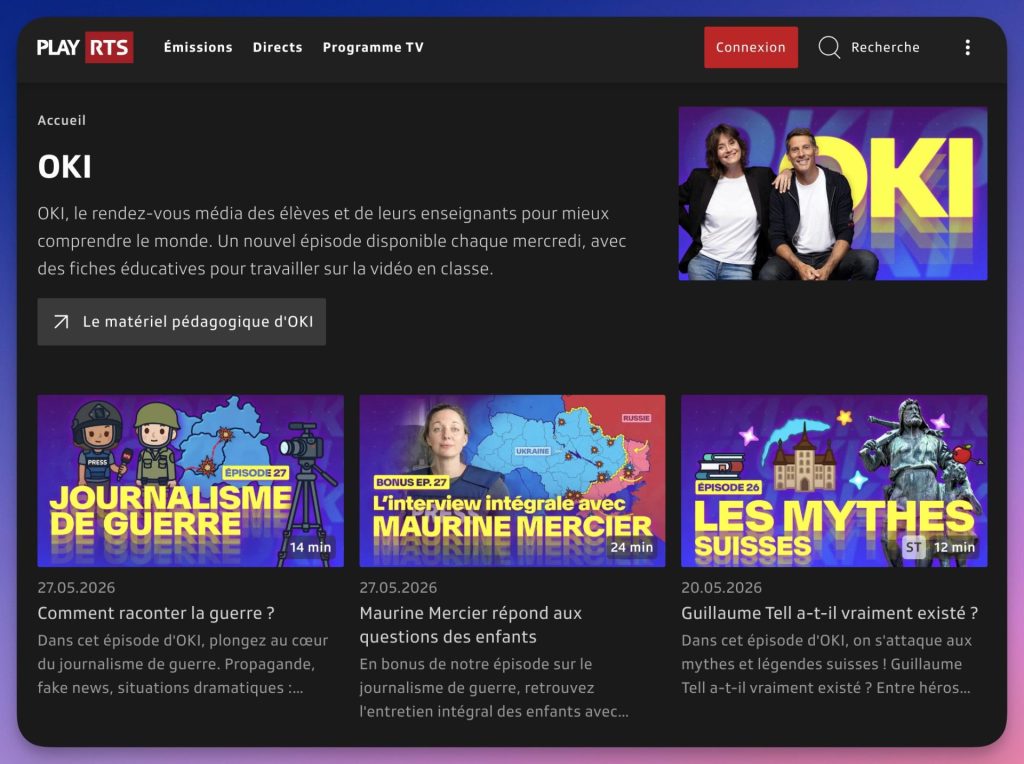
Table of Contents
OKI (RTS), what is it: an educational video magazine for 10-12 year olds
An episode of OKI lasts between 8 and 10 minutes. A new release every Wednesday at noon on Play RTS, then goes on Saturday morning on RTS 1. The format is based on a participatory approach: two groups of five to six children, from all the Romand cantons, take turns as mini-reporters and learn to film themselves.
It is therefore children who ask the questions and conduct the survey. It changes a lot of things in the tone. We are not in the top-down documentary, we are in real curiosity, with the hesitations and formulations of children. This makes it easier for your students to recognise themselves.
Everything is free, accessible online, without creating an account. For a French, Belgian or Quebec teacher, it is the digital version on Play RTS that is required: we throw it whenever we want, we pause it, we go back on a passage. Flexible.
It is this combination of short format, adapted tone and topical topics This makes OKI an interesting resource for the class.
Developments and themes addressed
OKI started in September 2025 with two episodes dedicated to artificial intelligence, one to learn how to Recognize an AI-generated image, the other to explain how generative AI works. The topic was topical. But stopping there would have been a shame.
In May 2026, we are at more than 27 episodes. And the themes have become much broader. Some examples of what was discussed:
- ‘Why do we fall in love?’: emotions, friendship, self-love
- ‘Where do Pokémon come from?’: the story of a global franchise, between collectible cards and marketing
- ‘How do you become a firefighter in Switzerland?’: a job explained by two young women firefighters
- ‘Why do we need to sleep?’: sleep cycles, dreams, nightmares
- ‘What is happiness?’: a real entrance into philosophy for students of this age
- An episode about the words of the younger generations, from "wesh" to "six seven", and how a word ends in the dictionary
There are also topics related to current events. For example, an episode on Japan was broadcast in connection with the Osaka World Expo.
Interest in you: there is something to draw according to what you are dealing with. Science, society, media, history, French language. No need to follow the series in order, each episode is taken in isolation.
OKI pedagogical sheets (RTS Education): class-ready activities
The real plus of OKI is not just the quality of the videos. This is the pedagogical support offered around each episode.
Each episode is accompanied by pedagogical sheets designed for use in the classroom. Teachers participated in their development, and they offer cross-cutting exercises, discussion tracks and practical activities that extend viewing. This is in line with the now compulsory digital education programme in Swiss schools, which is the result of a public service approach.
This material shall include in particular:
- Factsheets for teachers: They give you context, discussion tracks and activities to prolong the reflection in class.
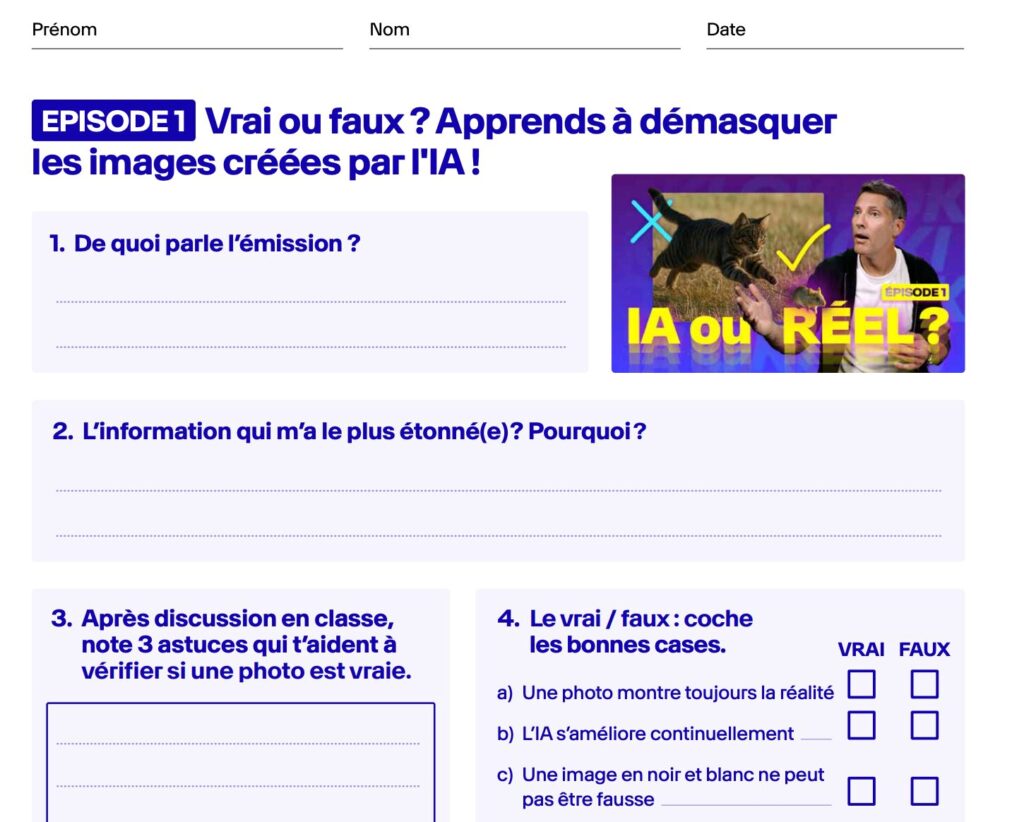
- Factsheets for pupils: Directly linked to the video, these sheets offer questions to be completed and exercises that anchor learning.
Concretely, this makes it possible to transform a short episode into a real working session. For example, after a video dedicated to AI-generated images, students can analyse multiple visuals, spot hints of manipulation and discuss the reliability of images online.
What I like
The approach by child reporters. It makes the content lively and credible in the eyes of the students, far from the tone of the textbook.
Total free, no account, no ads. At a time when so many tools are switching to pay-as-you-go six months after their release, it is appreciable. And this is public service, which reassures the long-term.
Cards designed with teachers. This is what turns a nice video into a usable session tomorrow morning.
The diversity of subjects, finally real. We can really build a small progression over the year.
What I like a little less
It is a French-speaking Swiss content, rooted in a Swiss context. Firefighters in Switzerland, Swiss schools, some local references. Nothing blocking, but a French teacher will sometimes have to contextualize a little.
The format is designed for 10-12 year olds, and it feels. Underneath, some subjects will go wrong. Above, college students may find the tone a little young.
And it lacks, to my liking, a clear thematic index on the teaching side to quickly find the episode that corresponds to its chapter. There is a bit of instinct in the catalogue. For 27 episodes it starts counting.
A free resource for the class (educational videos and pedagogical sheets)
All OKI educational content and resources are available free of charge on the RTS educational platform. For French teachers, this is the opportunity enrich your toolbox with quality content, complementary to existing national resources. The weekly rhythm of publications makes it easy to integrate this content into a pedagogical progression.
OKI Magazine illustrates the value of collaborations and exchanges of educational resources within the Francophonie. This Swiss magazine, thanks to the quality of its content and its universal pedagogical approach, demonstrates that the right educational resources have no borders. A great opportunity to diversify your teaching materials with relevant content. Oki?
 English