Last updated on 12 November 2026
The CDI Scrabble Box, you probably know it. Two chips are missing, the hourglass has long since disappeared, and the last part dates back to a rainy Friday in June. However, every time she comes out, something happens: students who never raise their hands start counting their points and defending the spelling of a word with astonishing energy.
In short, the desire to play with letters is there. The material, much less. Woodword is an online letter game that takes up the well-known principle of tokens placed on a board, a kind of online Scrabble without registration, free and without advertising. It may be of interest to French teachers as well as language teachers, from CM1 to high school.

Table of Contents
What is Woodword, in concrete terms?
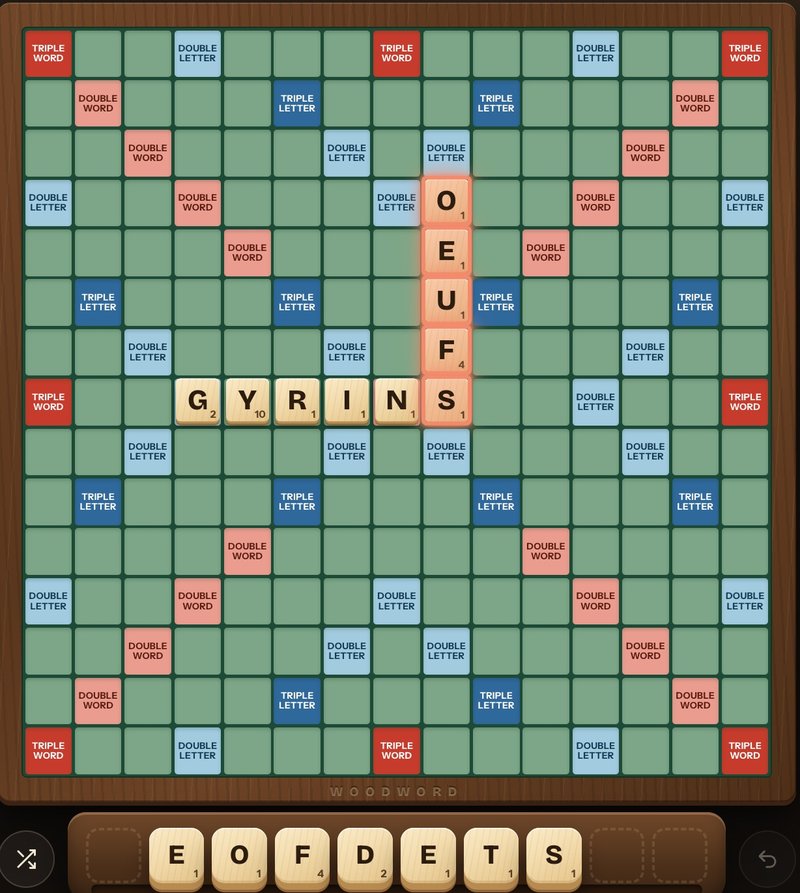
A tray of 15 squares out of 15, tokens that each have a value, seven letters on its easel and squares that double or triple the points. If you've ever played Scrabble, you're on well-known ground. Woodword, moreover, has no connection with the mark: it is an independent game, which runs in the browser, on computer or on the telephone, without anything to install.
There is a table for two to four players, and you can also play alone against a robot. Behind the game, there is an independent developer based in Germany, who used AI to write code and texts. A small project, therefore, not an educational platform with a big team behind it.
What you can do with this letter set in class
Open tables of four in two minutes
I opened a table to see what the course looked like. A first name to type (I put ‘Testprof’, for lack of inspiration), a click, and I arrive directly on the waiting screen, with a code and a button to copy the link. No email address, no password. In the computer room, this is exactly what is expected: the code is projected on the board, each group enters it, and the part starts.

What surprised me was the fineness of the settings. The host chooses the time per turn, from 30 seconds to 24 hours, or with no limit at all. It also decides whether a refused word makes you lose the round, as in a tournament, or whether you can resonate as many times as you want. With students discovering, I would clearly leave the second option.
Only constraint: a maximum of four players per table. For a class of twenty-eight, it will take seven tables, and seven codes to distribute.
See the score before validating
The score is displayed next to the word before it is validated, allowing you to try multiple locations. Sounds trivial. In use, this is what makes you think: a student immediately sees that a small word placed on a box ‘word counts triple’ yields more than a word of seven letters placed anywhere. From mental calculus, strategy, and a little vocabulary in passing.
The challenge of the day, a ritual all found
The Daily Rack Every day offers the same seven letters to everyone, with a simple goal: to find the word that pays the most. The draw changes at midnight UTC time (so around an hour or two in the morning with us). Projected at the beginning of the course, it becomes a ritual of five minutes: everyone searches in his corner, then we compare the finds to the painting. Those who have adopted Wordle in English recognise the pleasure of the shared daily challenge.
Revise a foreign language
The game is available in seven languages: French, English, German, Spanish, Italian, Dutch and Portuguese. Each has its own dictionary, tokens and letter values. A Spanish teacher can therefore start a table in Spanish, and according to the setting screen, the table then adopts the chosen language. If you are looking for other avenues for modern languages, I have put together a few applications for learning a foreign language.
The most formidable robot is called Nigel, and this is probably no coincidence. A tip posted on the reception notes that Nigel Richards won the French-speaking Scrabble World Championship without speaking French. I smiled, and I did not try my luck against him.
For whom? From CM1 to high school
- In CM1-CM2 and in sixth : A game against Theo, the quietest robot, to learn the rules without the pressure of a human opponent.
- In college : one workshop in groups of four, with a generous turn time. And when an unknown word is accepted by the game, it is an opportunity to check its meaning in the Dictionary of Francophones.
- In modern languages : a table in the language studied, to mobilize the vocabulary of the sequence.
- FLE or UPE2A : an allophone student can start in his language, if it is one of the seven, before switching to French.
- For a student dys : The ‘no limit’ option removes the time pressure, and you can type the letters on the keyboard instead of dragging them. On the other hand, I did not see any font or contrast settings.
Scrabble online without registration: what about student data?
Woodword is free, ad-free and purchase-free. The account is optional: it is only used to find its parts, statistics and ranking from one device to another. For the class, guest mode is more than enough.
On the data side, I looked at what the page loads. No cookies, no visible third-party scripts, just local storage in the browser. This is rather reassuring. On the other hand, I did not find on the website any privacy policy or legal notice, and for school use, frankly, it is a lack. It is impossible to know where the parties are hosted or how long they are kept.
Two reflexes, then. Ask students for a first name or pseudonym, never their full name. And leave aside the search for games with strangers, such as the ‘open table’ option, which makes your table visible to everyone. By default, it remains closed: only those who have the code can enter.
What I like / What I like less
What I like
- No account: a code and a first name are enough.
- Free, ad-free.
- The score displayed before validating.
- Adjustable turn time, up to ‘no limit’.
- Seven languages and three robots of different levels.
What I like less
- Neither privacy policy nor legal notice on the site.
- The reception of the game was displayed in English at my home. Younger people may need a hand to display the French version.
- A project carried by a single person, with no guarantee of duration.
A tray, seven letters, and the desire to beat the neighbour
A good one letter set basically asks very little. Woodword adds above all what was missing from the old CDI box: the calculation of points, and a game launched in two minutes from any station. To be tested for a vocabulary ritual or a workshop in a computer room, keeping an eye on the issue of data as long as no privacy policy is published. The game can be found here: Woodword.

 English