Last updated on 12 May 2026
In the computer room as on personal devices, Google remains the reflex : efficient, fast, familiar. But this reflex also opens up useful questions in the classroom: economic model, data, results bias, environmental impact, and now place of AI in research.
Ecosia proposes an interesting alternative for the school: a search engine that finances tree planting projects through its advertising revenues, and that puts forward a transparency approach (regular reports).
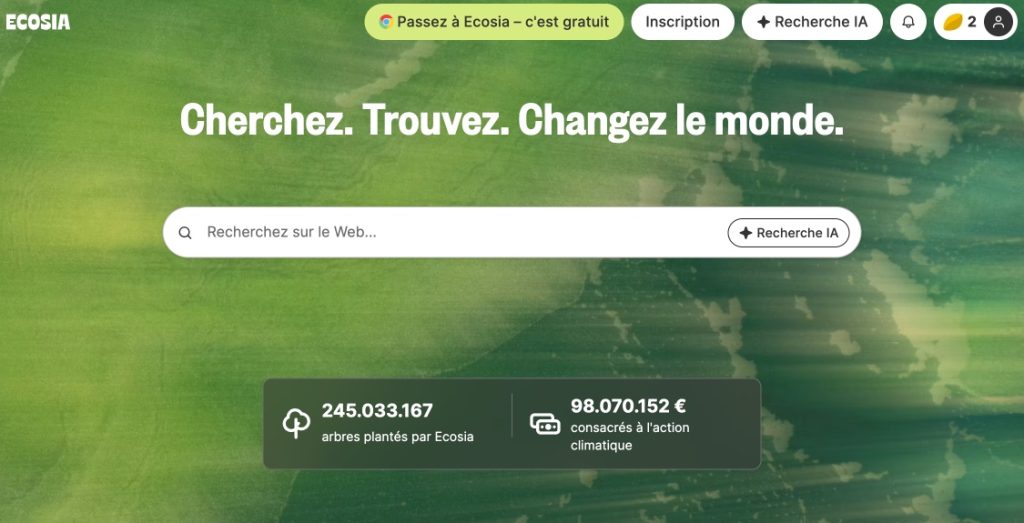
The Ecosia search engine has been around for a while now and now also includes artificial intelligence functions. An eco-friendly search engine to unravel or rediscover.
Table of Contents
How does Ecosia work in practice?
Ecosia is a search engine multi-supplier : its results are based on partners (in particular: Microsoft Bing, sometimes Google according to the regions) and on EUSP, a European initiative developed jointly with the engine Qwant.
Specifically:
- you achieve results comparable to those of the dominant engines;
- you can get students to work on a very topical NDE issue: who produces the information displayed, and according to which choices?
- advertising revenue is used to finance Ecosia’s projects (plantation, etc.), with a tree counter that makes the impact of using the tool visible.
Ecosia’s “AI turn”: two modes, two uses
It is now impossible for a search engine to ignore artificial intelligence. While most players in the sector are rushing towards this technology, which is often criticised for its high energy consumption, Ecosia has chosen a different approach.
The German company has just launched new AI-based functionalities, with a promise: to offer advanced technology while respecting its green commitments and protection of personal data users.
Ecosia deploys (and highlights) two complementary AI features.
1) AI Overviews : summaries at the top of the page
When you start a search, Ecosia displays a Summary box at the top of the results, like the “overviews” popularised by other engines. The idea: give a quick overview with source links to check.
Ecosia presents these summaries as deactivable (if you want to stay on a “classic” link list.

2) AI Search : a conversational mode
Ecosia also offers a mode AI Search, accessible via a dedicated button, which allows dialogue with the engine for more complex requests (preparing a route, comparing options, finding recipe ideas, etc.).
In class, it is an excellent EMI Support : one can have a “fluid” answer produced and then ask the students to find, read and quote The sources behind the claims.
Privacy and Personal Data: What Changes (or Not)
Ecosia has an unambiguous position on the issue of confidentiality:
- anonymised searches and erased after 4 days;
- Hidden IP address with partners;
- Zero Tracker Cookie, zero resale of data to third parties.
In practice: pure yourself or for classroom research, it is reassuring. Students are not “profiled”, and you do not have to manage complicated GDPR consent.
Be careful though : Conversational AI (AI Search) based on models third parties. Ecosia says it doesn't store conversations, but it's prudent to remind students never to enter personal data in a request (name, address, etc.).
In your courses: how to use it in practice?
Here is four concrete paths to integrate Ecosia into your sequences, from EMI to ESD to AI education.
- Compare Ecosia and Google (EMI)Same request, two drivers: diversity of sources, place of the sponsored, types of content highlighted.Objective: understand that ranking is never neutral.
- Mapping a request (EMI)Students list: keywords, sources found, date of publication, author/editor, angle, evidence.Objective: go from “I read a summary” to “I am conducting an investigation”.
- Exercise “IA = assumption” (EMI, IA)
- Step 1: the student asks AI Search to get a structured answer.
- Step 2: It must validate/deny 3 statements citing 2 reliable sources. Objective: to install a verification reflex (and avoid the effect “it is written so it is true”).
- ESD: sobriety and digital debateGuided discussion: what is AI for here? what does it bring? what does it cost (energy, infrastructure)?
Objective: to go beyond the “for/against” and to reason in practice.
The Real Questions to Ask (and Teach)
Let's be clear: AI, even “well-intentioned”, remains probabilistic. It can produce very convincing … answers and sometimes incomplete or erroneous.
So, golden rules in class: require legible sources (author, date, publisher), systematically cross-check (at least 2 sources), learn a simple routine (source → cross-reference → citation), and to give priority, where relevant, to resources institutional or recognized (working the difference between primary, secondary and opinion sources).

An alternative to Google … and a good pedagogical pretext
Beyond the technical features, Ecosia represents a interesting alternative at Google, Bing and others Yahoo. Each research contributes to the financing of reforestation projects around the world – more than 200 million trees planted to date – and sober AI tools that respect both privacy and the planet.
In class, it is also a educational gesture : show that it can be done differently, that digital tools can be thought of differently, and that every use counts.
Then, Why not test? Whether for your personal use, an EDD project, an EMI sequence, or simply to initiate a discussion about our digital choices, the Ecosia Engine offers a simple, free and committed starting point.

 English