Last updated on 29 October 2026
Written production in CE2. Three fingers stand up at the same time, with the same question: "It's written how, helicopter?". The dictionary of the class is there, on the shelf. Except that a child who doesn't know there's an hour at first will never find it. And photo, he will seek it wisely to the letter f.
In short, it is precisely this blockage that wants to lift The School Dico, a free online phonetic@ dictionary, from CP to 3rd grade, where the student searches for a word through sound, then chooses the right spelling himself thinking about his sentence.

Table of Contents
What is Le dico des écoles, concretely?
The principle holds in one line: the student types the word as he hears it (elikopter, foto, chato) and the dico shows him all the scriptures that are pronounced in this way. Each proposal comes with an example sentence, usually a short definition, an image and an audio recording.
Behind it is a teacher. Franck Rouillé is a school teacher in Loire-Atlantique, former ERUN and former digital education advisor, and he has co-signed two tools that many colleagues are familiar with: The Dictated Box and LibreOffice of Schools. The dico was born in La boîte à dictées, where it helped students reread their dictations, before becoming a site in its own right. Good work with really useful resources. Bravo!
You have to put it between two things you already have. The paper dictionary assumes to know the beginning of the word. The spell checker replaces the wrong word without asking anyone. The dico of the schools stops voluntarily before: it proposes, the student slices.
Searching for a word from sound: a test of a phonetic search tool

I started with the example given to me by its author. I typed "voi". Six answers: way, ways, voice, and a verb block that regroups see, see, and see. Each card has its sentence ("His voice was soft"), and it is the sentence that does the job.
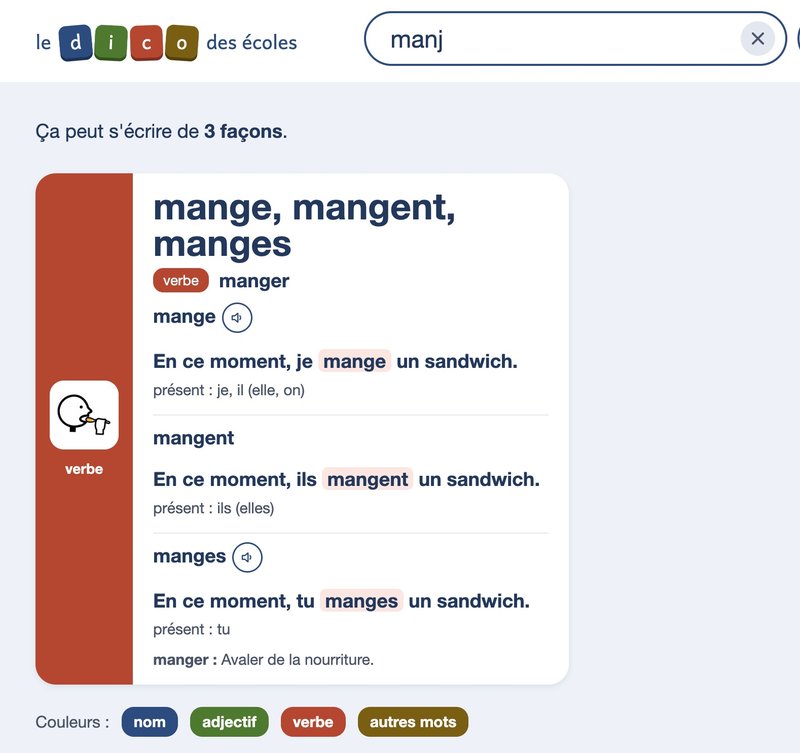
Then I tried "manj". The dico returns eats, eats and eats, indicating for each form the subject that goes with it (I, you, they). With "manje", we go to ten answers: imperfect, simple past, eat, eat, and the past participle in all its granted forms, with a trick at the bottom of the page to choose (replace by "bite"). This is where I understood the intention. The dico does not give the answer, it forces to wonder who does the action, at what time, and if the word is in the plural.
The keyboard of sounds, for those who do not yet know how to write a sound
A button opens a keyboard where the student touches the sounds he hears, in order, with reference words or with images. An option also allows you to hear each sound. For a CP or a student who bumps into "oin" or "eu", it's a real front door.
The Complete mode and the tips of homophones
By default, cards are reduced to the word and sentence. In "Full" mode, each homophone displays a small trick. For "sè", for example: it is, these, is, his, know and know, with markers of the type "we can say that is" or "we can add - there after the name". A session on homophones can start from there, projected on the board.
The two recognized spellings
The site accepts the rectified spelling of 1990 and the traditional spelling. It first displays the rectified spelling, the other in parentheses: ognon (onion), appear (appear). The student finds his word regardless of the version he types.
For which students and at what point in the class?
- During writing : the student blocks on a word and looks for it alone, without queuing at the office.
- At proofreading of a production of writing or to the correction of a dictation, to remove a precise doubt.
- At the TBI, in collective : compare worm, glass, worm and green, and justify the choice from the sentence.
- In college, to check in a few seconds a word that makes you hesitate. I typed "run": only one answer, run.
- At home, with a simple link, for homework.
The site was clearly designed for dys students: Andika font (drawn for children who learn to read), a color by nature of word, words spoken by real voices, pictograms. If you accompany these students, it complements well the resources of the GMF kit for dys students. I would add the allophone students, for whom hearing the word and seeing it illustrated probably helps as much as the definition.
Free of charge, without account: and student data?
This online phonetic dictionary is free and ad-free. It is in beta, and its author specifies that it will remain free afterwards. No account, no registration, nothing to install: it opens in the browser, on computer, tablet or phone (a connection is obviously necessary).
On the question of data, the legal notices are clear. The site is hosted in France. It places a single technical cookie, which disappears when the browser is closed. Searched words are saved to identify gaps, without an IP address or account, and deleted after 13 months. No resources are loaded from another site.
A word about AI, since the question will come. Some of the definitions and example sentences were written or simplified with the help of AI tools and then reread, according to the site. On the other hand, no AI responds to the student: the results come from a dictionary and rules written in advance.
What I love, what still traps
What I love
- The student remains master of choice. The work on agreements and terminations is done when it is needed.
- Verbal forms accompanied by their subject and their time.
- Zero counts, zero ads, and a data policy readable by all.
- The keyboard of sounds, which opens the tool from CP.
What I like less
- Example phrases are sometimes very mechanical. "A very long time ago, I was eating a sandwich" made me smile (I imagine quite well the head of a CM2 in front of this antique sandwich)...
- Some approximate results: by typing "o", I got "hop" in the middle of water, up and down.
- Ten answers for a single sound is a lot for a young player, even in reduced mode.
The site also invites you to report a missing word or phrase to contact@ledicodesecoles.fr. If you use it with a class, your returns will serve directly.
A dico who does not spell in the student's place
Besides a nice realization and a very successful graphics, what I liked here is the bias. A school dictionary that assumes not to correct anything, and to ask questions rather than deliver an answer. It does not replace either the paper dictionary or the learning of alphabetical order: it takes over when the student does not know where to start. For other uses (meaning, synonyms, complete conjugation), our selection of free online dictionaries remains useful.
To be tested as soon as the next writing is produced: The School Dico.

 English