Last updated on 12 May 2026
Matilda is an academic search engine to improve access to reference and citation data Often overlooked in research.
It also poses, in fact, as an alternative to search engines like Google Scholar. Matilda is based on open data and free software. It is based on the principle of equal treatment of all scientific texts and their authors.

The idea is to give academics and researchers as much control as possible over how their work is referenced and cited. The fact that at the origin of the Matilda project was a team of French researchers coordinated by Didier Torny of the CNRS and carried out by Huma-Num There must be something to do with it.
Available data on more than 130 million works and academic works and their authors
Matilda's corpus is based on scientific literature indexed since 2019 in open databases and archives such as Crossref, Pubmed Central, ArXiv, and RePec, unPaywall and Orcid. These bases cover a wide range of disciplines and sources.
Matilda provides free extended access to an impressive amount of scientific and technical data.
The search engine gives a fair place to academic content excluded from some proprietary tools such as Web of Science (WoS) and Scopus. It adopts a principle of equal treatment of all scientific texts and their authors.

Daily updates
Matilda has the great advantage of offering regular updates. Very regular even. The The project website states that Matilda is updated daily with new texts from a wide range of sources. These updates include not only the addition of new content but also the revision and modification of existing texts.
On average, between 300,000 and 600,000 texts are processed every day. A significant part of this volume, which reflects the focus on updating, is devoted precisely to changes.
It takes approximately 2 days between the moment a document is published in one of the sources and the moment the document is accessible from the Matilda interface.
Advanced search and standby functions
Matilda offers advanced search features. You can enter keywords or phrases in the search for academic articles relevant.
Then you You will be able to use filters to refine the results. You will be able to sort the results by type of document, by author, by date or by large available sources.
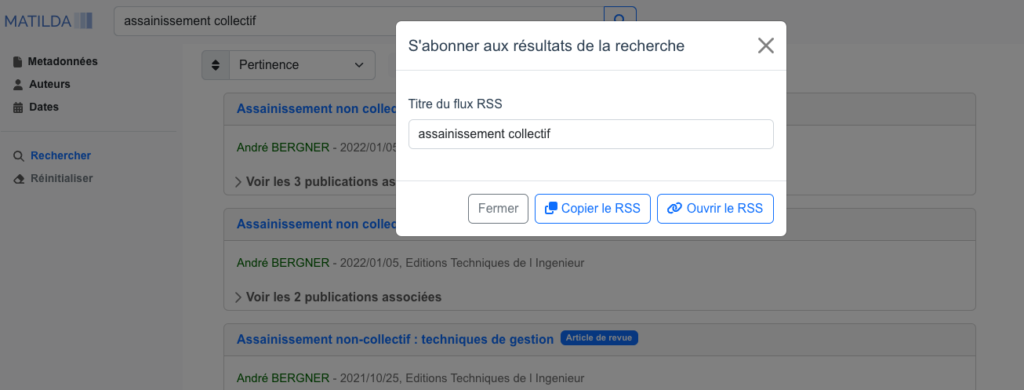
The platform offers a very convenient function by allowing you to create an RSS feed from the results of a search. Thus, you You will be able to stay up-to-date on a topic or an author and be informed of any new results associated with your research.
Matilda is positioning itself as a credible alternative to Google Scholar with fairer and more controlled access to academic content.
The tool would prepare an even more powerful new version with new functions. We'll follow this closely. In any case, it already has its place alongside academic search engines such as Base or ScanR.
By proposing a more transparent and fair academic research, Matilda tries to redefine how academic information is sought, cited and referenced, placing power in the hands ofs main stakeholders – researchers themselves.
 English
Congratulations for this great tool! Let us hope that it will help stem the looting of French material and intangible resources by the American Ogre.