Last updated on 12 May 2026
What if we took a little height? The internet is full of websites, blogs, articles and applications of all kinds that help us to better understand or make better understand our solar system. I selected five. 5 online resources to share to discover and size our good old solar system.
Table of Contents
JoshWorth

This beautiful scientific blog offers an online graphic representation of our solar system that allows you to properly size distances. The starting point of the demonstration: the moon = 1 pixel.
It is up to you to scroll on the screen to navigate to meet the other planets. And scroller, and scroller … Beautiful realization and some surprises that I let you discover.
Link: JoshWorth
SolarSystem Scope
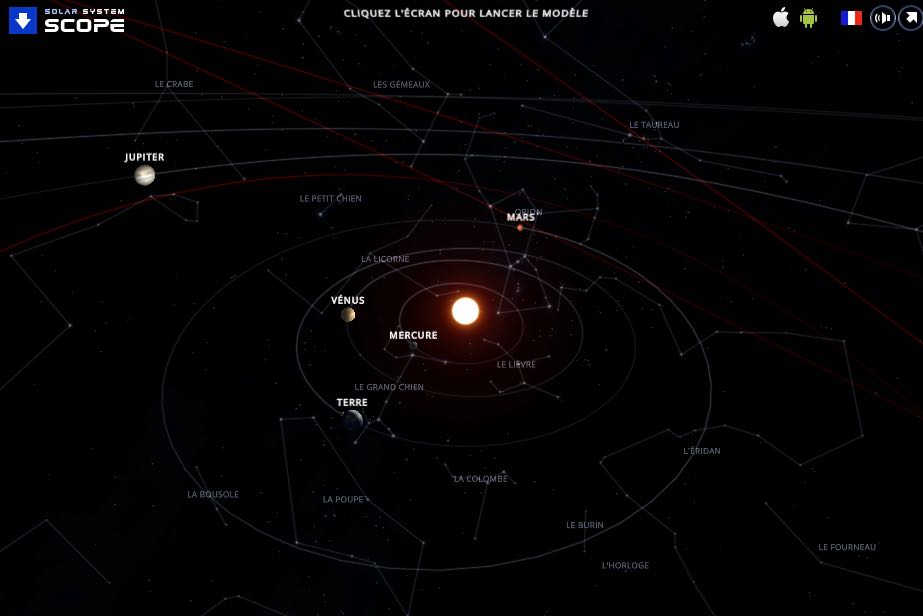
Much more classic, this site offers a 3D navigation of our solar system with a whole series of information panels and different views of planets or stars a little in the way of the unbeatable Stellarium Online Planetarium. Many options available with representations made in Flash quite successful. Small plus not inconsiderable, SolarSystem Scope offers a mobile version for your smartphones to slide the sky in your pocket. The site is in English.
Link: SolarSystem Scope
WorldWide Telescope

Web giants could not miss an exploration ground like this. This is the case for Microsoft, which offers this virtual telescope. It is an already old scientific reference resource reserved for experts and researchers, the result of a collaboration between Microsoft, NASA and prestigious American universities. This year, this reference resource should be made free and open source for the entire community. To visit carefully, be careful not to get lost in the infinite … Formidable space.
Link: WorldWide Telescope
Google Mars

Much larger public, this site proposed by the giant Google allows to discover the surface of the red planet. You will be able to navigate the surface of Mars as if you were on Google Maps. Your young students may spend time playing with the zoom in search of small Martians … Google compiled almost real-time data from NASA. Impressive.
Link: Google Mars
Google Moon

The counterpart of the previous one but for our muse the moon. Here again you will be able to navigate the surface of the moon as if it were at hand. As a bonus you will be able to discover the precise places where the different Apollo missions have landed.
Link: Google Moon
A short list of five resources that I found interesting. It's up to you to complete.

 English
1 Response
[…] also includes images of the planets, satellites and asteroids of the solar system, images of several nebulae and artistic representations of the constellations, y […]