Last updated on 12 May 2026
Paralleltext is a amazing online service that offers to help you learn a language by reading and listening to great classical texts.
While there are some flaws in the realisation, Paralleltext is still a good idea. It’s about learning a language by immersing yourself in a great classic of literature. The tool allows you to listen to excerpts from the book in the language you are learning. It also allows a online translation automatic passage listened to. The service will parallel or side by side the text in the lagoon you are studying and in the language you speak.
The use is quite simple. No need to register. On the homepage, you first choose the language you speak and then the language you want to work or learn. A good dozen languages are available, including of course English, Spanish or German, but also Italian, Polish or Finnish.

You will then choose a book to practice. Some 20 books are proposed. Great classics Alexandre Dumas, Victor Hugo, Jules Verne or Émile Zola. The text on the first page is displayed. By hovering over the sentences with your mouse, they are colored yellow. If you click on it, the text is read aloud in the language of your choice. You can listen or repeat as many times as you want. In front of each sentence, there is also a small symbol with two arrows linked. By clicking on the symbol, the sentence is translated into your language. Practical.
You will be able to browse long excerpts from each book by listening to the reading aloud in the language you study selected passages. You can also see him getting the written translation.
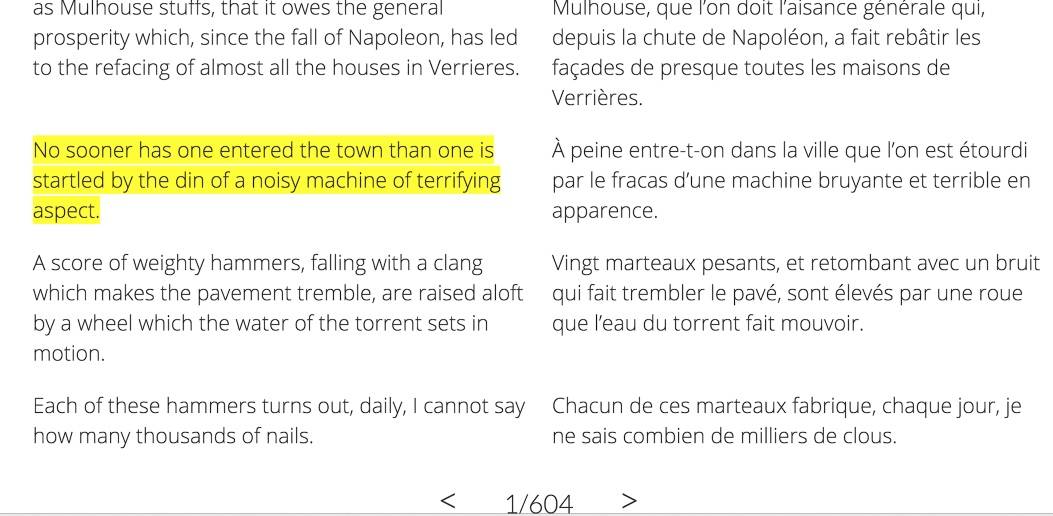
Paralleltext also offers a very convenient two-column reading mode. On the left the text in the language you are studying, on the right the same text in French. By clicking on the sentences you will hear the reading aloud.
A very simple service, but one that opens up interesting perspectives It allows you to practice a language based on reading and listening. The proposed voices are still a little too artificial and the rhythm of speech sounds a little too synthetic, but the result is quite honourable.
Paralleltext is completely free.
Link: Paralleltext

 English
A big thank you to Fidel for his valuable work for the class.
As regards Paralleltext, which I did not know, I would make a small reservation with regard to reading, which in English cannot bring anything to a pupil or learner because of the strong French accent . Of course, I may have misunderstood how it works. If you have information for effective settings, please communicate it. Florence
I confirm what Viquerat writes. For German, this is catastrophic: it is read with the French pronunciation (there are even words missing from the text that sometimes appear) and the intonation is also very bad. The result is absolutely incomprehensible … If the idea is interesting, there is still a long way to go to achieve a workable result.
Thank you Philippe and Florence,
You're right, these flaws you point to are real. This is what I suggested at the beginning of the article. The idea is good but can do better in terms of implementation. Much better.
Hello everyone,
First of all, a big thank you to Fidel for all these resources and ideas. In fact Paralleltext is very interesting to illustrate the problems of oral comprehension based on a prosodic shift. Otherwise, it is really good to (re-)discover classics.