Last updated on 15 May 2026
Preparing a subject for maths training often takes longer than you would expect. You have to find the right exercises, vary the sources, select the relevant questions, look after the layout, and then produce a document that can be distributed or shared with the students.
Maths Forge seeks to simplify this work. This online tool, free and free, allows to quickly compose personalized topics from the annals of the mathematics specialty of Terminale.
In a few minutes, you will be able to build a topic adapted to your progress, to a specific chapter or to your class level, and then export it as a PDF or LaTeX file. Simple, practical and directly usable. Maths Forge is part of the spirit of the Forging digital commons : propose open, useful and reusable resources for teachers.
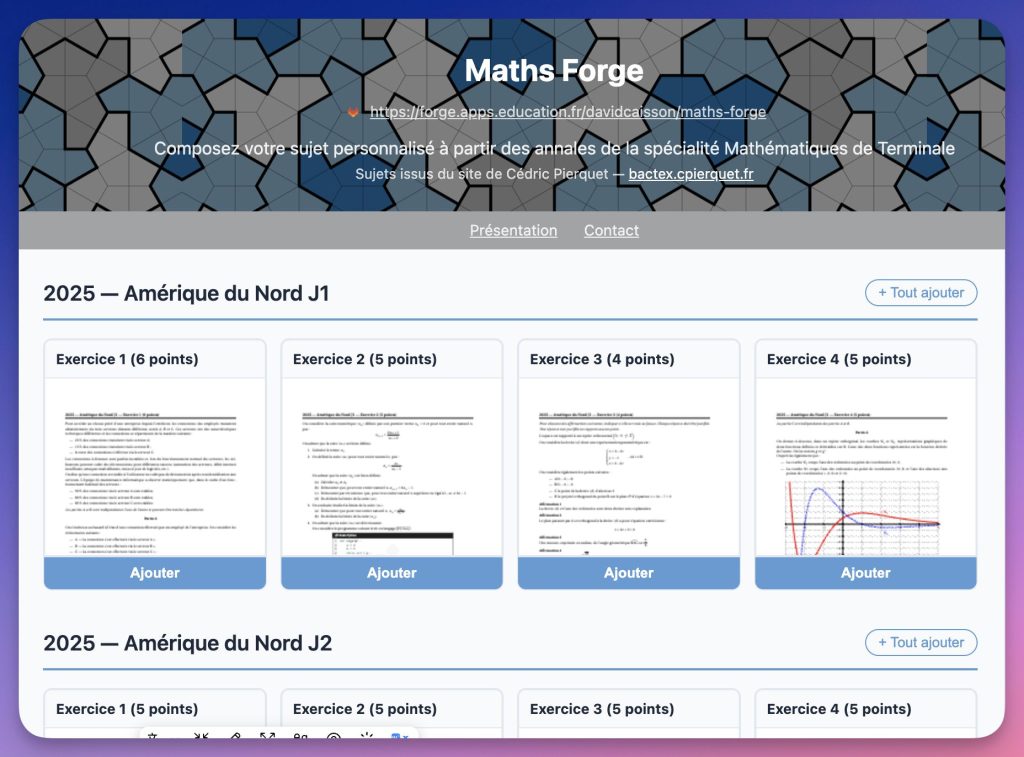
Table of Contents
Math annals transformed into a tailor-made subject
Maths Forge is an online tool, free, without account, developed by David Caisson (thank you and congratulated in passing) hosted on the Forging educational digital commons, the French public infrastructure dedicated to open source digital projects in education.
Its principle is simple: it allows you to compose a subject of mathematics personalised by drawing exercises in the official annals of the specialty Mathematics of Terminale, then download the result as a PDF or as a LaTeX file.
Compose your Math subject without starting from scratch
Finding the right exercise in the annals
Upon arrival on the interface, you can filter the available topics by year and by academy. Convenient if you want to vary sources or avoid giving your students exercises they might have already encountered.
But the most interesting feature is elsewhere: Thematic research in the LaTeX source code of the exercises. Clearly, you can type a keyword "drugs", "probabilities", "matrix" and Maths Forge will search the subject code to find the corresponding exercises.
You can even search for mathematical symbols in LaTeX. Type \\alpha and the tool will try to find the exercises using the bijection theorem. It is a bit technical as an approach, but for a math teacher familiar with LaTeX, it is a very effective shortcut.
See the exercise before adding it to the topic
Before you add an exercise about yourself, you can see one overview. No unpleasant surprises: you know exactly what you are integrating, its length, its apparent level of complexity, its context.
Assemble a homework adapted to your class
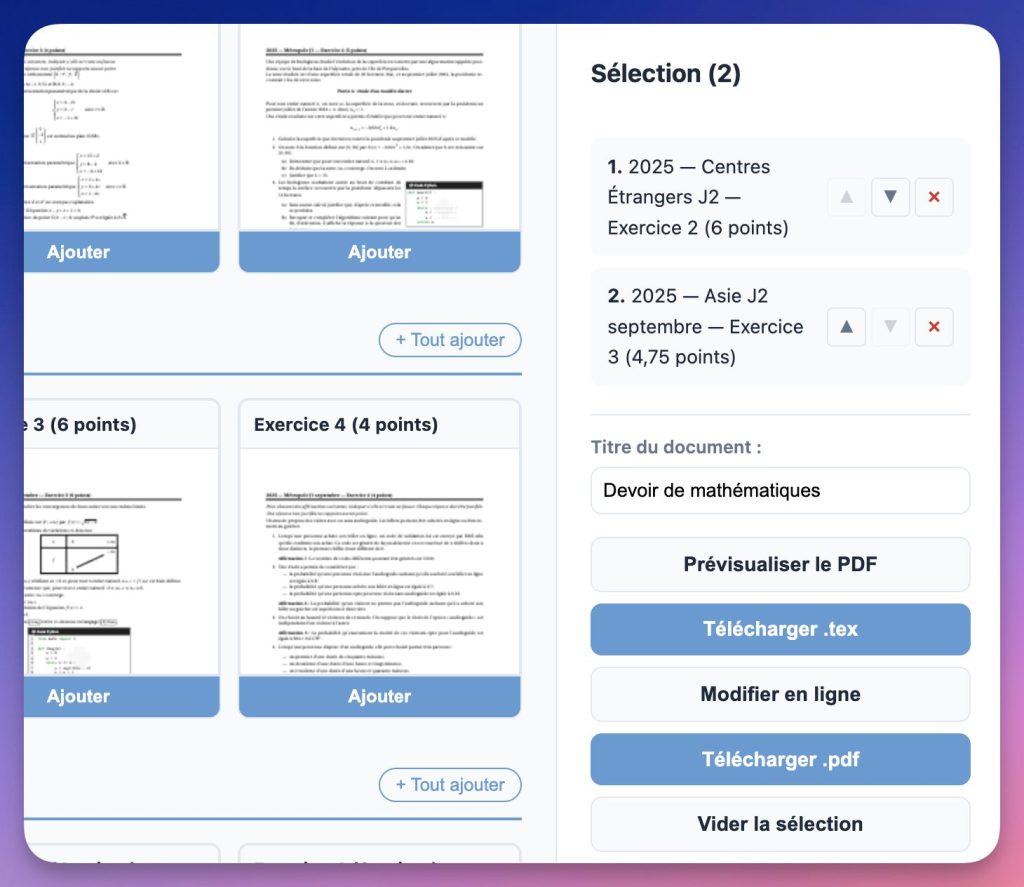
You select the exercises one by one, you build your subject to measure. You decide the order, the combination, the overall level of difficulty. Everything remains in the interface, without complex manipulation.
Export to PDF or LaTeX
Once you have made your selection, you can download the result:
- In PDF, ready to print or share with your students.
- In .tex file, if you want to edit the topic more finely with a LaTeX editor.
And for those who want to go further without leaving the browser, the tool also offers a editing and online compilation from the LaTeX file. Of what adjust the layout or customize the instructions without installing anything on your machine.
Some concrete use cases
Prepare a glue or homework on a specific theme. You are currently working on the suites with your students. In a few minutes, you assemble four exercises from different sessions around this notion. You get a consistent topic, well laid out, without having to type a single line of LaTeX yourself.
Variety of sources to avoid repetition. By filtering by academy and year, you avoid giving the same topics as your colleagues or previous years.
Prepare differentiated exercises. You select exercises that are more accessible for one group, more complex for another. Two different PDFs, two levels, all generated from the same interface.
Quickly create a white training subject. As the tests approach, composing a complete subject based on real annals is a common practice. Maths Forge makes this preparation much faster.
What Makes Maths Forge Really Practical
- Zero friction at the entrance. No account, no installation, it works in the browser. We arrive, we search, we compose, we export.
- A true digital public service. Hosted on the Forge of Digital Commons, developed in open source, MIT-0 license.
- Search in the LaTeX code. On paper, it may seem anecdotal. In practice, for a teacher who knows what he or she is looking for, it saves real time.
- Export in .tex. Those who master LaTeX will appreciate being able to take over the source file to customize it at will.
What I like less
- The interface is efficient, but austere. The tool is clearly designed by and for teachers accustomed to technical work.
- Thematic research requires a little practice. A colleague less comfortable with LaTeX might be a bit destabilised by some features (notably LaTeX code search). A filtering system by program notion would be a real plus.
A tool in the spirit of educational digital commons
Maths Forge also has an important interest from the point of view of digital commons. The project is proposed on the Forge of Educational Digital Commons and published under license MIT No Attribution (MIT-0). This means that the project can be freely used, copied, modified and distributed, without any obligation to credit the author. It is difficult to make it more “open”.
This is a point to emphasise. In an educational digital landscape often dominated by closed, paid or non-transparent services, Maths Forge opts for openness. The tool is free of charge, easy to access and is based on LaTeX resources derived from the work of Cédric Pierquet, well known to LaTeX users.
The presentation of the project also indicates that it was carried out with the help of an artificial intelligence, Claude Code. This is interesting information, as it also shows how AI can help produce useful, targeted and reusable tools for the educational community.
My opinion of Maths Forge: a sober but really useful tool
Maths Forge is a good surprise for Mathematics Teachers from Terminale. The tool meets a specific need and does so well: quickly compose a custom topic from reliable annals and then export it in a directly usable format.
I particularly like its positioning: no unnecessary overlay, no mandatory account put forward, no excessive promise.
It is a sober, well-thought-out tool built in the spirit of educational commons. It is free, open, transparent about its sources and limits. For a math teacher in high school, it is clearly to be tested.
👉 Go to Maths Forge : davidcaisson.forge.apps.education.fr/maths-forge
 English