Last updated on 1 July 2026
Imagine the scene: your students observe a map of the Atlantic where the famous La Route du Rhum race takes place between Saint-Malo and Pointe-à-Pitre. They spot the trajectory of a boat, and start to wonder how you sleep on board in the open sea, why so much plastic accumulates in certain ocean areas, or what the winds really do to a racing trimaran.
The questions arise on their own. And the lesson about marine currents or plastic waste, the one you struggled to bring alive, suddenly makes sense.
This is exactly what is proposed The Blue Race : transforming a great maritime race into a pedagogical guideline to raise students’ awareness of the protection of the ocean.
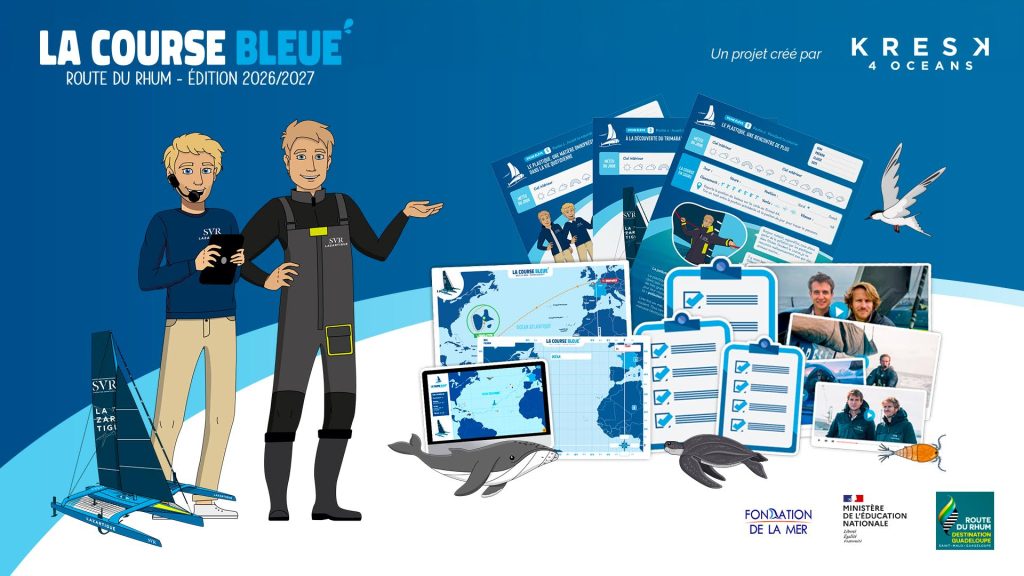
The Blue Race is based on storytelling and adventure to stir up students' curiosity. Following a boat in full crossing, deciphering storms, winds or distances traveled fascinates children spontaneously. And when their attention is there, scientific and environmental topics are much easier to set up in the classroom.
The scheme is aimed, in particular, at pupils in Cycle 2 and Cycle 3. And it's completely free.
Embark your class on the adventure of the next Route du Rhum with this free educational kit that I suggest you discover.
Table of Contents
What is La Course Bleue?
The project is proposed by the endowment fund KRESK 4 OCEANS and the Foundation of the Sea, in partnership with the Ministry of National Education.
The idea behind this Free Pedagogical Program is clever. An offshore race like the Route du Rhum naturally fascinates children. Life on board, storms, distances, boats spinning at impressive speeds all capture attention. Once students are taken on board, scientific and environmental subjects naturally enter the classroom.
On paper, this kind of promise is often oversold. For use, The Blue Race keeps its promises.
Free educational resources for cycles 2 and 3
The teaching area provides access to a set of resources organised for classroom use.
Find all the educational resources directly on the website.
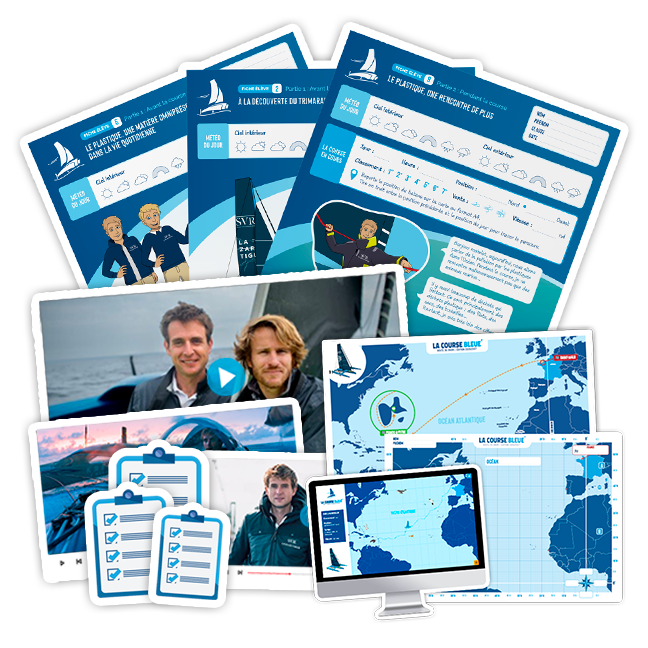
These include:
- 16 educational sheets to raise students’ awareness of the protection of the ocean;
- 17 immersive videos to discover offshore racing, trimaran, crew and marine issues;
- a map offered in several formats, useful in both geography and science;
- 3 online questionnaires to test students’ knowledge;
- one interactive map to discover or experience the race with the class;
- a page of Q&A around offshore racing, the life of skippers and the boat;
- 3 challenges to move from theory to practice
Resources cover several disciplines: sciences, geography, French, EMC, but also mathematics or plastic arts according to the projects imagined by the teacher.
This is not a promise of facade. The formats are varied enough for everyone to find their entry, depending on their class level, the time available and the objectives of the sequence.
How to use La Course Bleue in class?
What makes La Course Bleue really usable is its multi-stage structure. The project can be used on an ad hoc basis or become the focus of interdisciplinary work over several weeks.
Before the race: preparing for boarding
Before departure, students will be able to discover the crew, the boat, the course, the oceans to be crossed and the first concepts related to navigation.
This is the perfect time to work on geographical landmarks, weather conditions, distances, winds or maritime vocabulary. The class prepares itself as if it were going to leave, too.
During or around the race: follow, understand, question
The interactive map allows the adventure to enter the classroom. With a projector (or a TNI), it works very well: you display the position, have the distance travelled estimated, and end with a ‘flash’ question orally.
The issues that are sometimes difficult to bring to light then naturally arise: Why doesn't the boat go straight? What does an anticyclone actually change? How do you live on board a boat launched in the middle of the Atlantic? What is the link between this adventure and the protection of the ocean?
The race becomes a pedagogical soap opera. And this is where the system works best.
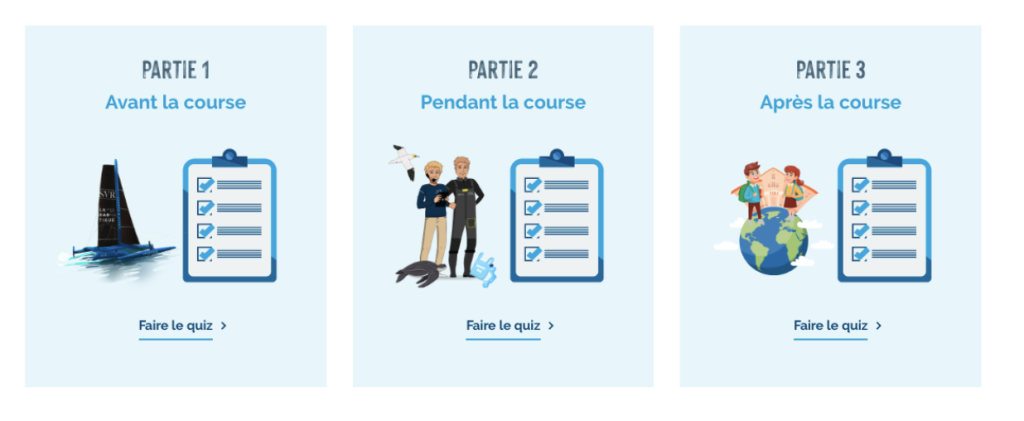
After arrival: Moving from adventure to action
After arrival, the resources make it possible to prolong the reflections towards concrete actions. Students can prepare an exhibition, create awareness posters, write a logbook, debate plastic waste or devise solutions to better protect the ocean.
What I like about this educational kit on the sea
The great strength of La Course Bleue is its anchoring in a real adventure. We do not start from an abstract discourse on the environment. We start from a boat, a crew, a crossing, a map and concrete questions.
I also like the fact that the device is free of charge, the variety of media and the consistency with the programmes. The teacher can draw a card, project a video, use a quiz or build a real interdisciplinary project. No need to take everything. You don't have to turn your class into a sailing school either.
One point to note: the device is aimed mainly at cycles 2 and 3. College teachers may be able to adapt some content, but this is not the main target displayed.
My opinion of La Course Bleue
The Blue Race is an original, well-constructed device with the intelligence not to forget the reality on the ground. It can be used simply, with a map to be projected, a video to be commented on or a questionnaire to be proposed. It can also be made a more ambitious project around environmental education.
Its originality lies in this successful mix between maritime adventure and awareness-raising on ocean protection. Students follow a race, get attached to a boat, discover life at sea, and gradually understand why the ocean is a fragile environment that needs to be preserved.
Some teachers will find subject to an interdisciplinary project over several weeks. Others will only use one fiche to launch a debate on plastic waste. In both cases, the trip is worthwhile. To explore on lacoursebleue.fr.
What exactly is the Route du Rhum?
Created in 1978, the Route du Rhum is a solo transatlantic race between Saint-Malo and Guadeloupe, organized every four years.
In class, it is an excellent pretext to work on geography, weather, navigation, but also the protection of the marine environment.
For more information and to follow the associated resources, see the dedicated page: Route du Rhum.

 English