Last updated on 5 July 2026
You are preparing an art history session and you need a picture, but a real, clean, large format, not the blurry thumbnail that hangs on the third page of Google. Or it is a history teacher who is looking for a portrait of a period, a colleague of letters who wants to illustrate a reading, a doc who is setting up a virtual exhibition. We all know this moment: the image must exist somewhere, but where, and above all, is it allowed to be used in the classroom?
In short, the Ministry of Culture discreetly maintains a page that answers a good part of the question: one Directory of online catalogues of international museums. A long list of museums, sorted by country, that have put their collections on the web.
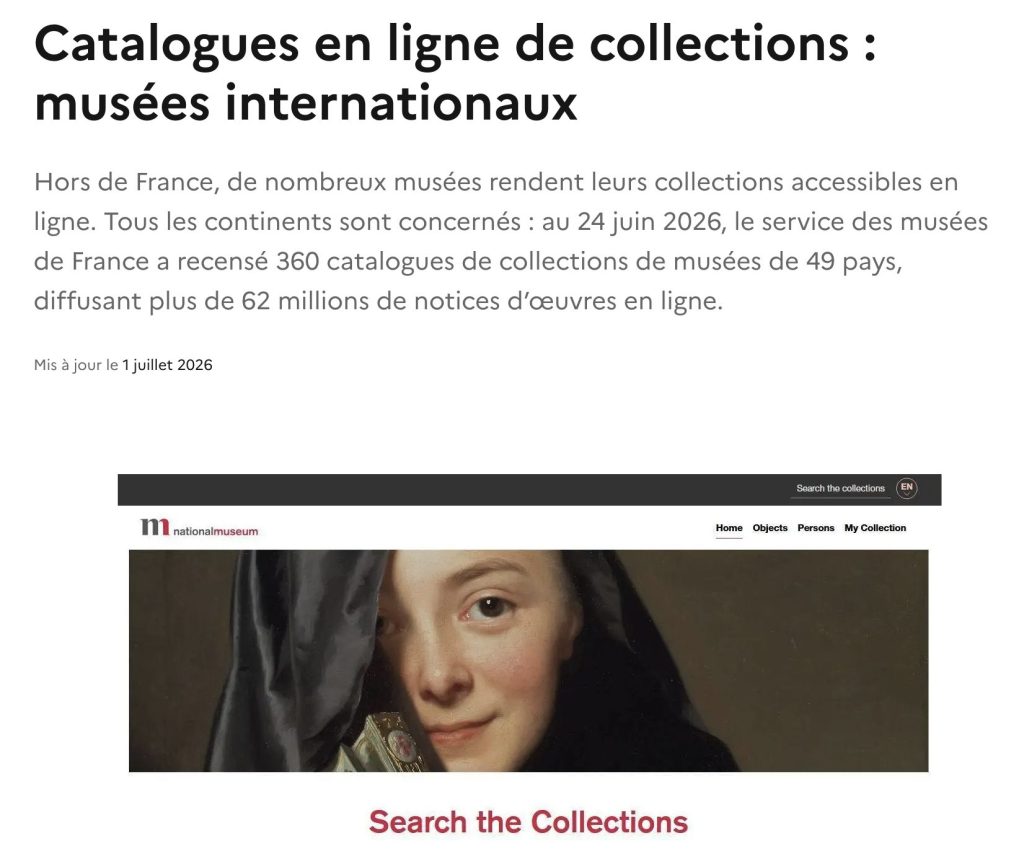
Table of Contents
What exactly is this repertoire of international museums?
It is not a tool in the usual sense of the blog. No magic button, no AI, no app to install. It is a page on culture.gouv.fr that lists, museum by museum, the institutions around the world that have made their collections available online. The Met in New York, the British Museum, the Prado, the Rijksmuseum, the National Gallery in London, the Vatican Museums, and dozens more, all the way to unfamiliar regional museums.
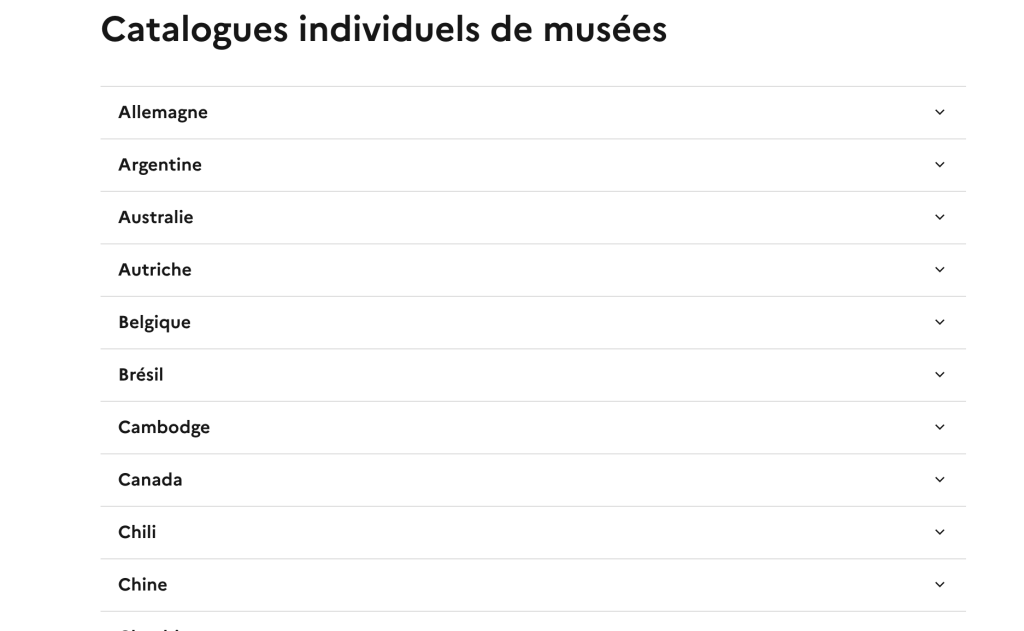
Concretely, you arrive on the page, go down to the ‘Individual museum catalogues’ section, and navigate by country. Each entry is a direct link to the museum’s online catalogue, often accompanied by a small note: number of records, language available, and above all, where this is the case, the valuable mention ‘freely reusable high-definition images’. In short, it is a directory. But a directory kept by people who know what they're talking about, not a tinkering list on a blog.
What can be done in class
The real value lies in one word: the pictures. Many of these museums offer the downloading of high-definition works, and some of them completely release them from rights, including for commercial use. In other words, clean material for your supports.
Illustrate a course without asking rights questions
When a museum indicates that its images are under free license (CC0 for the most generous), you can drag them into a slideshow, a card, a digital manual, an establishment site, without fearing the legal misstep. For the history of the arts, history, letters or languages, it is a huge reservoir.
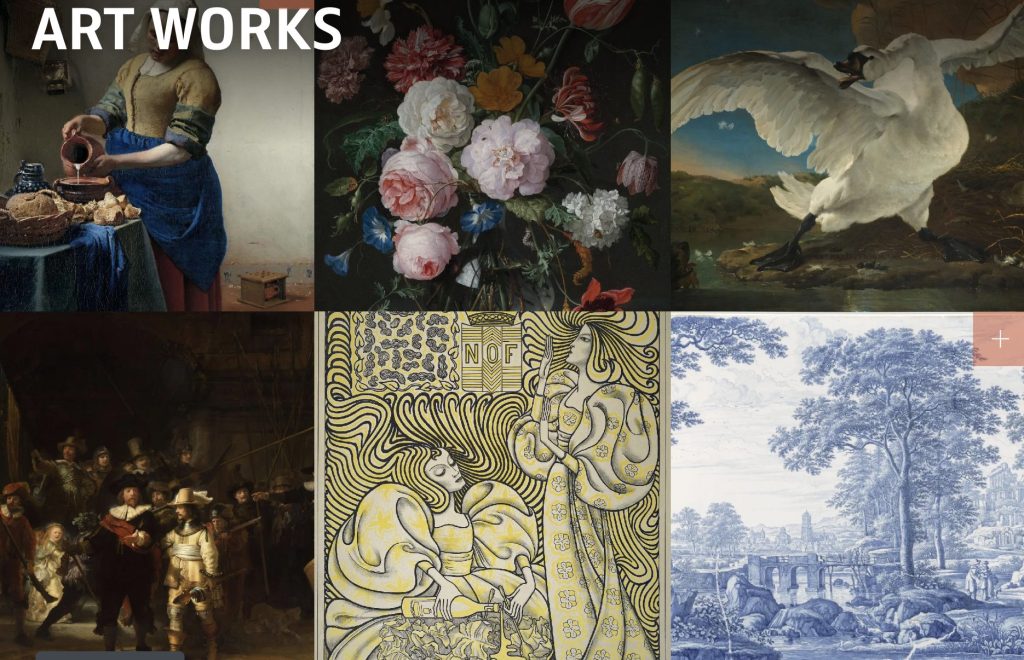
I randomly opened the collection of the Statens Museum for Kunst in Copenhagen and the Rijksmuseum: we download a work in full definition in two clicks, without account, without watermark.
Introduce students to the details of the works
Several museums offer very high definition, sometimes with the Mirador viewer (from the IIIF consortium) which makes it possible to zoom very far into an image, compare two works side by side or annotate. For a student, seeing the subject matter of a painting, the painter’s gesture, a detail that cannot be seen with the naked eye, changes the way of looking. This is the kind of thing that makes a plastic arts class significantly more alive than a textbook reproduction.
Support for languages and cultural openness
As the catalogues cover all continents, a language teacher can draw on them: browse the Prado in Spanish, the Kunsthistorisches in Vienna in German, a Japanese museum of which some records are translated. The museum interface itself becomes a small field for reading in a foreign language.
For whom, and at what time of preparation
This page is intended primarily for those who prepare, rather than for students directly. A teacher of history-geo, history of the arts, letters, a documentary teacher who is setting up a virtual exhibition or an EMI session on the image. It is used upstream, when you are looking for the right resource, not directly in front of the classroom.
That said, there is nothing to stop high school students from dropping on it for research work: ask them to look for a specific work in the catalogue of a large museum, to note the notice, to quote the source. We are working on the credit reflex and the issue of rights, which is never wasted time. For younger people, on the other hand, the navigation by country and the interfaces often in English make the exercise less obvious: It is better for the teacher to sort upstream and arrive with a selection.
How much does it cost and does it require an account?
The ministry page is completely free and obviously does not require any registration. It is published under an etalab open license, like the rest of the site. No data collection, no trap: it is an institutional resource.
Be careful, however: Each museum to which the page refers applies its own rules. Some release everything, others reserve high definition for private or scientific use, some request registration to access their database. The Ministry’s note is an honest reminder: of the hundreds of museums listed, only about twenty offer free reuse for all uses. The reflex therefore always remains the same, check the licence on the museum site before incorporating an image into a medium. The directory opens the doors for you, but it is up to you to read the conditions once you enter.
What I like
- A serious selection, held by the Ministry, rather than a list of dubious links. We trust the source.
- The coverage is global and impressive: all continents, from giants to small regional museums.
- The "freely reusable high definition" mentions throughout the list save a lot of time.
- Free, without account, under open license. Nothing to install.
What I like less
- The presentation is austere. It is a long page to unroll, without an internal search engine: we navigate country by country, the old-fashioned way.
- Most of the dates of the links visit date back to 2020. Inevitably, on so many links, some have had to move or break since. I have not tested everything, far from it, but there is a risk of a dead link.
- It is often necessary to go through English, and dig a little in each catalogue, the interfaces of which vary greatly from one museum to another.
To keep in your favorites
This page does not replace the engines that will directly search for the image for you, such as Museo or the bank ArtVee, which aggregate the free funds of several institutions and save you museum-by-museum navigation. If your need is to quickly find a royalty-free table, start with it, or with the Smithsonian Open Access.
What the Departmental Directory In addition, supply is the direct source. When you want the precise work of a specific museum, with its real record and the best quality available, this is where you will find the front door. To store in a corner of your favorites, for the day when a manual image will not be enough.
FAQ
Do I need to create an account to use this page?
No, the page of the Ministry of Culture is free and open access. Some museums to which it refers may request registration to access their database, but this is the exception.
Can we really use these images in class without risk?
It depends on the museum. Some of the institutions release their images for all purposes (licence CC0), others limit them to private or educational use, and still others protect high definition. Always check the license shown on the museum website before embedding an image in a broadcast medium.
Are the interfaces in French?
Rarely. The Ministry's page is in French, but the catalogues of foreign museums are most often in English or the language of the country. Some Japanese museums offer notices translated into French, but this is not the rule.
What is the difference with Google Arts & Culture?
Google Arts & Culture aggregates and stages collections in a licked interface. This directory sends you directly to the official catalogue of each museum, with its original notices and often a better image definition. It is more raw, but closer to the source.
Is the page up to date?
It was updated in November 2024, but the majority of links were verified in 2020. On such a vast repertoire, some links have since broken. The Ministry also calls for inactive links to be reported.
 English