Last updated on 12 May 2026
Matheros (often written matheros) is a Mental Computing Software and one Online Mental Computing Platform This makes learning numbers as natural as playing. Designed for students of the CP, CE1, CE2, CM1 and CM2, the platform plunges children into a world of math superheroes where every right answer advances their character.
His secret? A progression by levels organized in skill belts inspired by video games, which motivates students to train again and again.
What if calculating becomes as fun as playing? Your students will love mental calculus… and you too!
Like the other tools of the team of MonSchool – e.g. Rallye Lecture which I had the opportunity to present here Matheros is particularly successful. This quality is also due to the fact that this mental calculus tool was designed by a teacher for teachers, and this is felt in every detail: content, ergonomics, monitoring. Teacher registration is free and fast; trial month Free is offered to test Matheros with your class without obligation.
Table of Contents
The game to motivate and progress in calculation
The site offers a Pedagogical approach based on the game and on personalization. Each student trains at their own pace, according to their needs, in a universe of superheroes. Far from the traditional exercises often perceived as daunting, Matheros is a Playful mental calculation tool for primary school which plunges children into a captivating universe: they must save a city by successfully completing mental calculation missions.
This approach naturally helps the pedagogical differentiation, since each student progresses at his own pace, without being constantly compared to the others. The student interface displays a Mission Map where the following appear:
- challenges that have already been successful,
- those to come,
- the belts to be obtained.
Success unlocks new areas, new challenges and changes the avatar.
The young math hero is welcomed in a colorful universe where he chooses his avatar. Over the course of success, this superhero gains in equipment, skills and status. This visible evolution reinforces motivation, especially among students who doubt their math abilities.

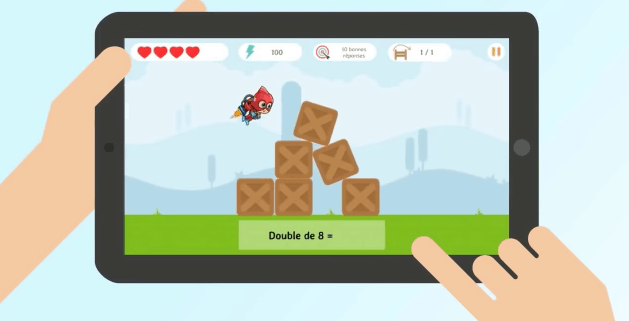
In Matheros, the student can be led to distribute passengers on trains or to choose the right route for a character, so many small challenges that hide Online Mental Calculation Exercises adapted to his level.
The proposed games and exercises are clearly inspired by the codes of the video game. The sequences allow the child to handle, memorise, train then dautomate calculation techniques, until a final validation of his skills. In Matheros, students can, for example:
- distribute passengers on different trains,
- choose the right path to move a character forward,
- participate in "races" of mental calculation in duel.
Unlike traditional paper exercises or more basic online calculation sites, Mathéros offers a scripted adventure who immerses the child in the role of hero. This ludified pedagogy pushes the student to working maths by returning to train with pleasure, which establishes a regular practice essential to progress in mental calculus.
The 4-step methodology: learn, train, play, validate
Behind the playful world of Matheros is a highly structured pedagogical methodology. Each new competency of mental calculus follows the same four-step path, designed to make sense before moving towards automation.
1. I am learning: manipulating to understand
In this first phase, the pupil manipulates and visualizes numbers. Mathéros proposes:
- the Representations of units, tens, hundreds,
- objects to move (passengers, cubes, groups, etc.),
- concrete situations to give meaning to operations.
The pupil does not just apply a ‘rule’: he sees what he is doing, which helps him to construct a clear representation of the calculations.
2. I am training: consolidating automation
Once the concept is understood, Mathéros proposes a series of progressive exercises to consolidating achievements :
- the level of difficulty increases slowly,
- the response time is taken into account,
- errors make it possible to target what still needs to be reworked.
This phase installs the first automatisms, but without pressure.
3. I go on a mission: play to automate
This is where Matheros shows its full effectiveness. Exercises become real missions :
- calculation runs,
- choice of the right path,
- Timed challenges.
Students quickly take to the game. Repetition, often experienced as tedious in mental calculus, Here, it becomes natural: missions are linked together in order to succeed in the next stage of the adventure.
4. I validate: attest the mastery
Last step: the student must validate the skill worked. It passes a targeted test that verifies the control of the targeted calculation. If successful, he gets his corresponding belt, unlocks the rest of the course and sees his superhero progress on the mission map. In the event of difficulty, Mathéros suggested going back to training or the ‘I am learning’ phase.
From the student’s point of view, this route is very legible: I am learning → I am going on a mission → I am valid. From the teacher’s point of view, it ensures that each Mental Computing Competence was actually worked before being taken for granted.
Skills belts to advance students
Matheros takes over the principle of competence belts, Well known in pedagogy. Students learn, play, train and validate all mental calculation skills in a coherent universe.
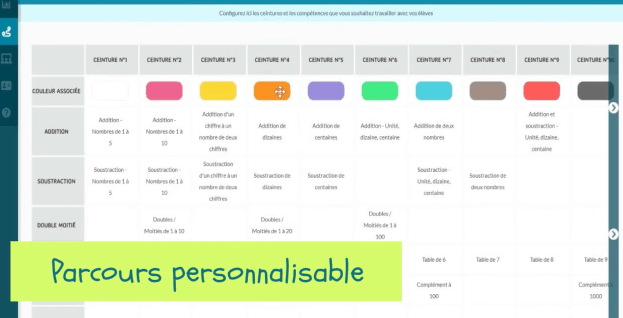
Each calculation skill (additions, subtractions, multiplications, divisions, thoughtful mental calculation, posed calculation, etc.) is attached to a color belt. Students often start with the white or yellow belt, then climb the levels. This makes it possible to:
- to make progress visible,
- to value both small steps and major advances,
- Give each student a clear goal.
Each belt follows the methodology in 4 steps detailed above (I learn, I train, I go on mission, I validate). The teacher thus knows precisely what each belt validation covers and can rely on it for his cycle assessments, booklets or evaluations.
Personalized progressions in mental calculus
Mathero proposes a progression by color belts covering the skills of CP to CM2. You are free to customize this progression by changing colors or removing or moving some of the skills. The pathways can thus adapt to the rhythm and needs of each child, making them a real lever for pedagogical differentiation in class.
A practical dashboard for the teacher to monitor progress
This online educational software obviously offers specific access to the teacher. It is from this dedicated control tower that you will be able to create a class and enroll your students in it. You can compose groups, you can also just see him fine-tune the skill belts that will then be offered to students.
You will be able to customize the progress of the class and ensure a follow-up of pupils accurate, by visualizing the progress and results of the whole group but also of each individual.
The system makes it possible to assess effectively the skills acquired, in particular for multiplication tables.

Ergonomics is very well studied. Everything is clear, everything is done in a few clicks or with your fingertips on a tablet.
As a teacher you can project a series of classroom operations for a collective challenge, or let your students train at home between sessions, while tracking their progress from their dashboard. Practical.
A mathematical Escape Game as a gift to play with the whole class.
The Matero subscription includes ‘Escape math’, a digital educational escape game designed for use in the classroom. It consists of 6 episodes in the form of a collective adventure to be carried out in full class with a video projector to display the game. Your students will think individually or in small groups before pooling together to solve the puzzle collectively and move forward in history.

The puzzles mobilize skills of logic, mental calculation, problem solving and cooperation. This is a great way to work math differently, while strengthening the cohesion of the class group.
A detailed guide and ready-to-print templates for puzzles are provided to help you set everything up without wasting time.
Matheros is a great tool for train your students in mental calculus. They'll love it and they'll love you too. 😉
In conclusion, a tool to learn mental calculus while having fun
In short, Matheros brings an approach of Playful Mental Calculation the challenge of mental calculus atprimary school, and constitutes a Relevant Mental Computing Platform for Teachers.
Try Matheros now: teacher registration is free and in a few clicks, your students could soon claim their mental calculation session!”
Link: Matheros
Frequently Asked Questions (FAQ)
How do I register on Mathéros.fr?
Registration is simple and free for teachers. See you on Mathéros.fr, click on "Register" and follow the steps to create a teacher or parent account.
To create an account, you must provide an email address. The pupils will then only have to enter the Class code that you communicate to them to access their personal interface, without email address.
Is Matheros free or paid?
Mathéros offers different pricing plans adapted to schools, independent teachers and parents wishing to accompany their children. Count a little less than 20 Euros for a class of 25 students for a whole year. Consult the "Rates" section on the official website for more details. In any case, you can test the tool free of charge for 30 days.
What level of Matheros is it aimed at?
Mathéros is mainly aimed at students of CP to CM2, but may also be used:
- in ULIS class,
- in groups of school support,
- for 6th grade students who need to consolidate their automatisms.
The content follows the curriculum of the French primary school and allows students to train on a daily basis to progress.
On which devices can Matheros be used? ?
Mathéros can be accessed on any internet-connected device:
- computers,
- tablets,
- smartphones,
regardless of the operating system. This is a website, not of an application to be installed. The ideal in class remains the use on a computer or tablet for maximum comfort.
Are student data secure?
Matheros says he respects the Confidentiality of data and use appropriate security protocols to protect users' personal information. Student accounts are associated with a class and do not require a personal email address, which limits the collection of sensitive data. For detailed information, you can consult the privacy policy from the Mathéros website.

 English