Last updated on 26 May 2026
Update 2026. Article originally published in August 2016.
You are preparing a course on the French Renaissance. You are looking for something more lively than a manual, more reliable than a quick Google Images search. Something you could project in class or have your students explore independently.
In short, you want a real resource. Solid. Free. Accessible without installation.
It has been around for a while, but it has evolved so much that it deserves a fresh look. Google Arts & Culture devotes an entire project to Castles of the Loire, and what the platform offers today goes far beyond the 2016 folkloric virtual tour.

Table of Contents
Much more than just a virtual tour
Many teachers are still familiar with the original version: some Street View panoramas, some cultural marketing, an interface in English. It was already good. But the project has grown.
Today, the page The Châteaux of the Loire on Google Arts & Culture brings together:
- More than 2,100 works, photographs and documents digitized in high definition
- Of 360° virtual tours major sites (Chambord, Sully-sur-Loire, Château du Moulin …)
- Of online exhibitions written by experts and cultural partners
- Of videos overflights and short documentaries
- Of Thematic Collections from the partner castles
The partners are not second-tier institutions: Chambord, Chenonceau, Villandry, Clos Lucé, Angers, Chinon, Loches, le Rivau. They are the big names in the Loire Valley, which is a UNESCO World Heritage Site.
Please note: Google Arts & Culture celebrates this year its 15 years of existence. The platform, launched in 2011 as the Google Art Project, has grown considerably since its inception. The Loire project is one of the most successful examples of this on the French heritage side.
Four concrete ways to use it in the classroom
This is where it gets interesting.
Embark the whole class on an immersive tour
Street View tours remain the most immediate entry. We project, we navigate with the keyboard or the mouse, we explore the interiors, the gardens, the corridors. For students who have never set foot in a Renaissance castle, it is an effective contextual setting, much more telling than a textbook photo.
Chambord, in particular, lends itself to an excellent architectural observation exercise: the double revolution staircase, the terraces, the roofs. So many details that students can spot themselves before an explanation.
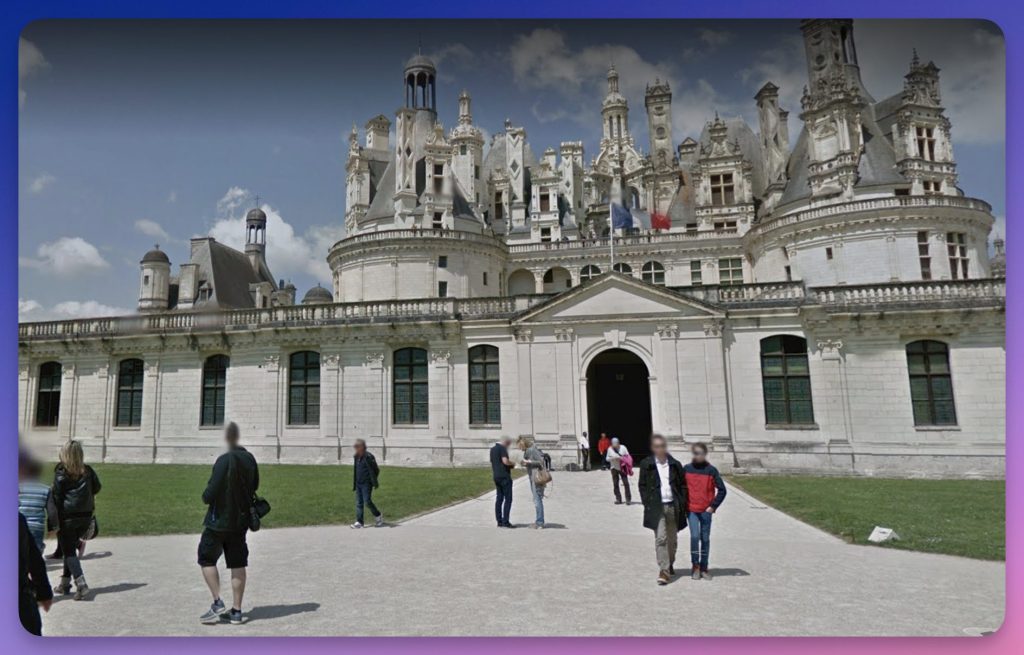
Thematic exhibitions signed by the castles themselves
The online exhibitions are perhaps the least known treasure of the project. They are carefully written by the teams of the castles themselves. It includes, for example:
- ‘1000 years of history’ : a chronology of the Loire Valley from the Middle Ages to the Renaissance
- Chambord, genius of the Renaissance : centered on the architectural genius of Francis I
- The Gardens : on the art of French gardens, very useful for a course on Villandry
These exhibitions are structured, illustrated, and can serve as a basis for work or presentation support. They are written in French.
More than 2,100 works to explore in high definition
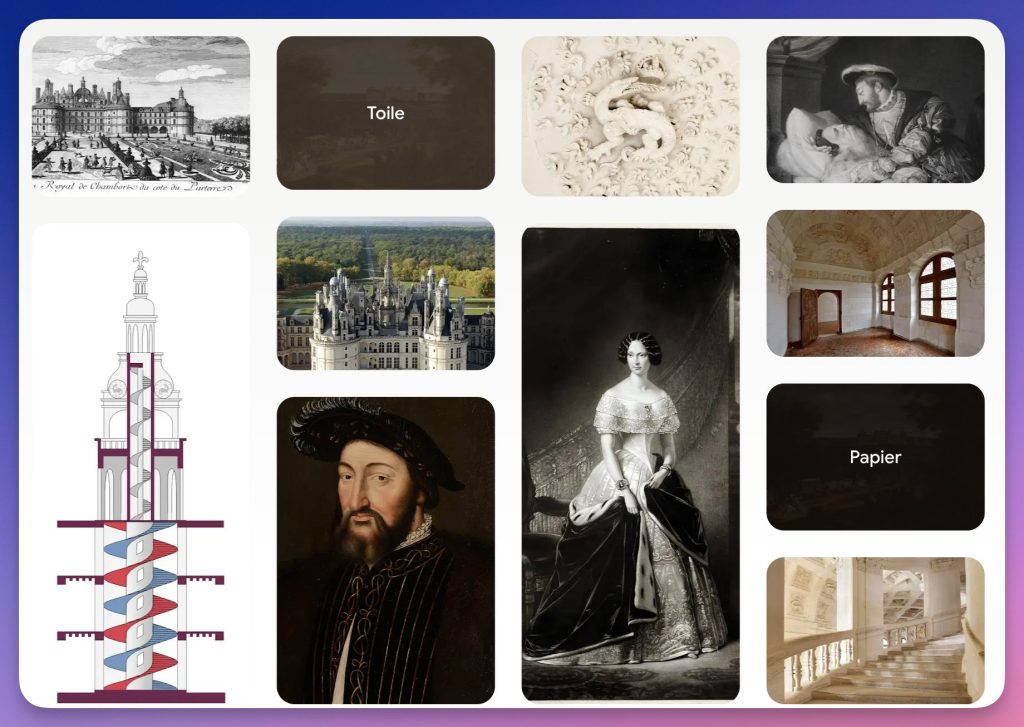
With more than 2,100 indexed elements (paintings, tapestries, sculptures, plans, aerial photographs, objects), the visual library is substantial.
A useful detail: resolution is often excellent. One can zoom in on a medieval tapestry of Angers, read the details of a portrait of Charles VIII, or examine the salamander, the emblem of Francis I, as one could never do in the castle itself.
It is a resource that can be used directly for iconographic analysis in the history of the arts.
Approach Leonardo da Vinci through the door of Clos Lucé
The castle of Clos Lucé, in Amboise, Leonardo da Vinci’s last residence, is one of the project partners. The documents and associated images make it possible to address the figure of Vinci in France, his last years, his workshop. An original angle to cross art history and political history of the reign of Francis I.
Strengths
The richness of the content is impressive. The platform is stable, maintained, accessible from a browser without any account. It works both on computer and tablet. No installation. No advertising. No fees.
The exhibitions provide real added value compared to a simple virtual walk: they were produced by the scientific teams of the castles, not generated in a hurry.
The overflight videos are spectacular and short, ideal as a hook at the beginning of the session.
I like less
Navigation between sections is not always intuitive. The project’s homepage is dense. It takes five minutes to understand the organisation before using it in class, otherwise you can get lost.
Not all castles are equally represented either. Chambord and Chenonceau have clearly been more documented than other smaller sites.
And then there is the question that often comes up: this is Google. The reservation is legitimate. Google Arts & Culture collects browsing data just like any other platform in the group. For a one-off projection by a teacher, the risk is limited. For autonomous exploration by students connected with a Google account, this is another story. This is not a reason to discard the resource, but it is a reason not to use it with your eyes closed.
For which levels and disciplines?
- History (4th, 2nd, Terminale) : Renaissance, French monarchy, heritage
- History of the Arts (all levels) : analysis of works, tapestries, architecture
- French / Literature : evocation of the Loire Valley, the royal court
- Languages (English) : English content can be used as a medium for understanding
- EMC / EAC : heritage education, cultural citizenship
- Primary (CM1-CM2) : with strong guidance, virtual tours are accessible and motivating
In practice
- Access : free, without a mandatory account
- Interface language : French
- Compatibility : web browser, computer, tablet, smartphone
- Direct link : artsandculture.google.com/project/loire-castles
To remember
Ten years ago, one could be impressed by some Street View panoramas in castles. Today, the Loire project on Google Arts & Culture has become a real documentary base : visits, exhibitions, high-definition works, videos, thematic collections.
In use, it is one of the most comprehensive free heritage resources available online to address this topic.
To be tested, or rediscovered if you had crossed paths with him in 2016 and forgotten since.
 English
1 Response
[…] Tice Tools […]