Last updated on 12 May 2026
Epsilon is another AI-powered search engine, Designed specifically for scientific and academic research.
Thanks to artificial intelligence, this platform gives access – in just a few seconds – to a colossal base of more than 200 million scientific articles and pre-publications, e.g. from Semantic Scholar (which indexes PubMed, arXiv, and many others). No more hours spent searching the databases: here, we type a question, and Epsilon provides a clear answer, sourced, and above all, directly useful. Basically, it is like talking to a colleague who is very knowledgeable … but who would have read all the scientific literature for you.
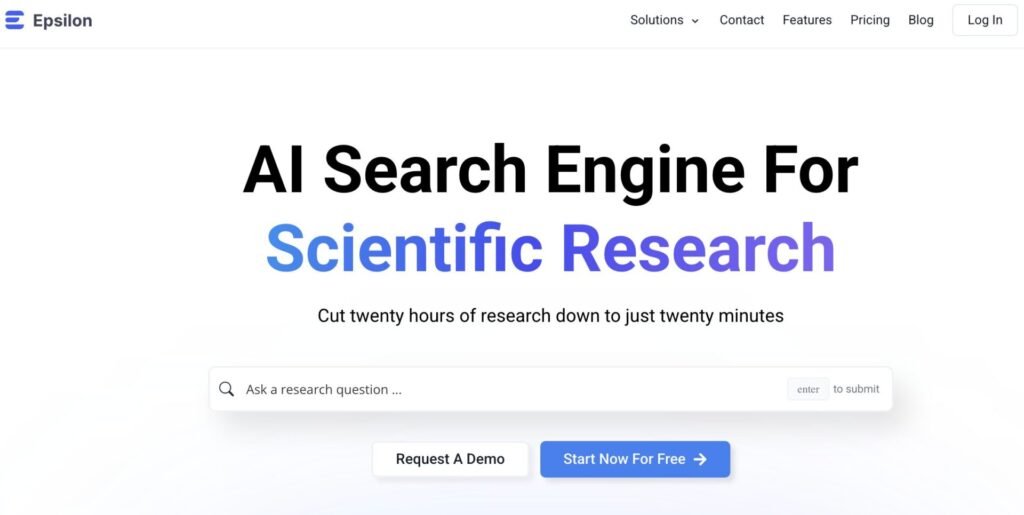
Table of Contents
A search engine that speaks your languageScientific …
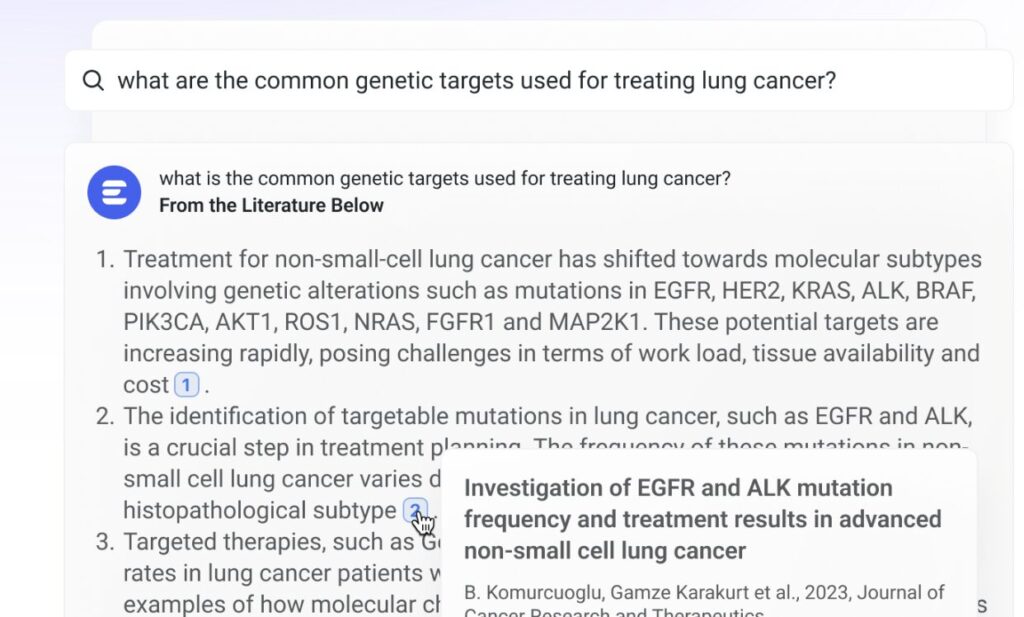
What is most striking about Epsilon is that we are not dealing with a search engine classic. Here, we can ask complex questions, such as ‘What is the impact of microplastics on male fertility according to data from the last 10 years?’, and get a structured answer, accompanied by precise quotations. It is as if ChatGPT had read PubMed, arXiv and many others. and that he finally knew how to quote his sources correctly.
Behind all this is GPT ‑4, assisted by a layer ofartificial intelligence who knows how to sort between solid information and hollow texts. Summaries do not simply identify keywords: the tool includes the substance of the articles, This makes answers often more useful than those generated by simpler tools.
Result: we save a crazy time, without sacrificing rigor. As regards the confidentiality of research, Epsilon anonymizes your requests and does not store any data related to your identity.
Epsilon’s bet? Reduce the hours of research or in any case facilitate them as much as possible. Says otherwise: what took hours can now be done in minutes, depending on your subject, your need and your level of requirement.
How does it work, concretely?
- Type your question in the search field. For example:
- What are the effects of intermittent fasting on cognition in adults over 60 years of age?
- Is there a link between screen exposure and language impairment in children?
- Let Epsilon grind. In a few seconds, you receive a Structured synthesis, with:
- A clear summary of the state of the research,
- Direct links to the articles used,
- The bibliographical references complete,
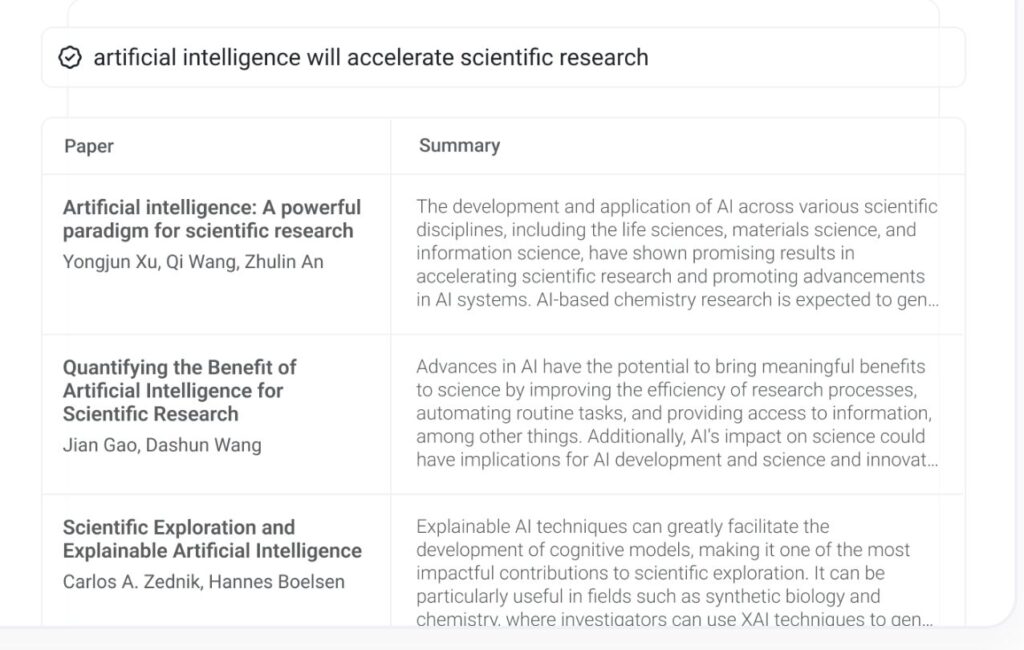
- And even comparative tables if several studies are crossed.
- Refine if necessary: you can rephrase the question, ask for more details, or explore a sub-theme.
- Import your own PDF, ask questions about it, organize them into libraries, annotate and summarize automatically.
A concrete example? You are preparing a seminar on the evolution of inequalities in access to higher education in Europe. A single query is enough to raise a Overview of the strongest publications, sorted by relevance, with up-to-date figures and reading tracks. You save valuable time, while maintaining a rigorous and documented approach. No need to peel Eurostat or to search databases OECD : Epsilon will take care of it for you.
What Epsilon does best (and how it can help you)
🔍 Smart Research
The " Functionality Investigation This is clearly the core of the reactor. You ask a question, and Epsilon gives you a clear summary, sourced, and often far more relevant than can be found elsewhere. To review what has been published, validate a hypothesis or quickly get solid quotes, it is a real time saver.
The engine also sorts the results smartly: between the Latest publications, the Most cited texts and articles deemed most relevant. Practical. And for those who make comparisons of studies or meta-analyses, Epsilon can cross several articles at the same time and identify common or divergent points. It is a bit like having a comparison table automatically generated, without having to do everything by hand.
🗂 Abstracts and personal library
Another strong point: we can Import your own PDF articles, and Epsilon creates hyper clear summaries important parts (intro, results, conclusion). Convenient when you have a stack of texts to read, but not in the afternoon to do so.
We can also create Thematic Libraries, annotate documents, and carry out research in its own archives. Frankly, to keep your references tidy and ready to use, it is almost a luxury.
🧠 Reliable information
The engine draws on serious bases such as Semantic Scholar, and focuses mainly on the validated literature by peers. Some preprints (such as arXiv) may also be included, but they are clearly identified as such. No unpleasant surprises, no questionable articles.
For teachers, supervisors and doctoral students
If you teach or coach students, Epsilon can save you time. For prepare a course with the Latest up-to-date searches, it is much faster than a conventional search. And to guide a student in their thesis or dissertation, it is a good way to show them how to structure a search, find sources Reliable …
An example? You need to update a course on artificial intelligence in education. A simple question asked to Epsilon will give you the most recent studies, examples of practical cases, and solid references that you can integrate directly into your presentation.
In disciplines that move fast (AI, medicine, … environment), being able to update a educational content in just a few clicks, it is not a detail.
By automating repetitive tasks (sorting articles, find a quote, make a summary), the tool gives you more room to think, write, compare, interpret.
A full subscription after a free trial of a few days costs around EUR 10. Epsilon offers a half-fare to students, and personalized plans for research centers, libraries and institutions.
A scientific search engine that counts
Epsilon AI is a recognised player in the ecosystem of tools for scientific research booming. It offers teachers and researchers unprecedented abilities to navigate scientific literature effectively. Integrating advanced AI technologies with rigorous academic sources creates a powerful and reliable research environment.
The promise is to achieve substantial gains in terms of efficiency, quality and accessibility of scientific and academic information.

 English